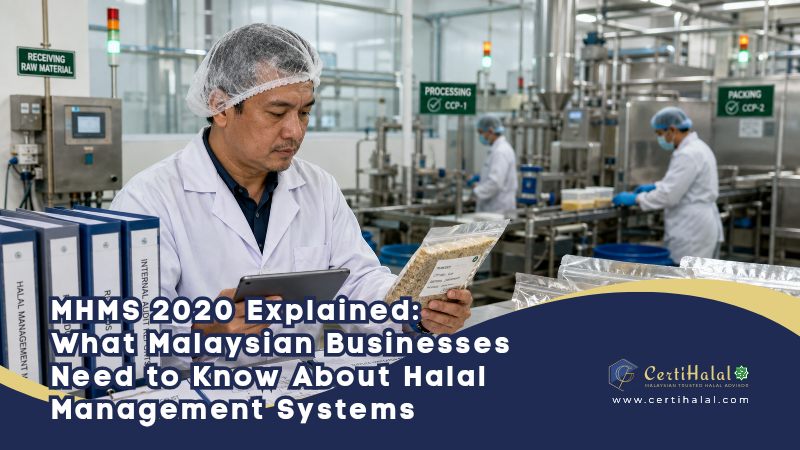
MHMS 2020 Explained: What Malaysian Businesses Need to Know About Halal Management Systems
Published on 15 September 2026Table of Contents
For Malaysian businesses, halal certification is not only about whether a finished product contains permissible ingredients. It also requires the business to show that halal integrity is controlled through its people, materials, processes, records and day-to-day operations.
This is where the Malaysian Halal Management System (MHMS) 2020 becomes important.
MHMS 2020 provides the framework for companies and applicants to develop, implement and maintain internal halal controls appropriate to their business and certification scheme. It distinguishes between the Halal Assurance System (HAS) and the Internal Halal Control System (IHCS), with different levels of control depending on industry size and scheme-specific requirements.
For business owners, this means halal certification should not begin with paperwork alone. It should begin with a clear understanding of how halal responsibility is managed inside the organisation.
What Is MHMS 2020?
MHMS stands for Malaysian Halal Management System.
MHMS 2020 was introduced as a reference for competent authorities, companies and applicants of Malaysian halal certification to establish and maintain internal halal management controls.
It should be read together with the applicable Malaysian Standards, the Malaysian Halal Certification Procedure Manual, fatwas, laws, regulations and halal certification circulars relevant to the certification scope.
In practical terms, MHMS 2020 explains how a business should organise halal responsibility internally, control halal risks and maintain evidence that its halal system is functioning.
The framework places responsibility on the company or applicant to ensure that Malaysian Halal Certification requirements are complied with at all times.
This is an important distinction. MHMS 2020 is not simply a document prepared for an audit. It is intended to reflect how the business actually operates.
MHMS 2020 Is a Management System, Not an Application Checklist
Businesses sometimes approach halal certification by collecting certificates, organising files and completing application documents.
Those activities are necessary, but they are not the same as operating a halal management system.
A functioning system should control matters such as:
- responsibilities within the organisation;
- raw materials and suppliers;
- operational processes;
- halal risks;
- traceability;
- training;
- internal verification;
- corrective action; and
- records.
For businesses implementing HAS, the documented system should correspond with the actual implementation of the company’s operations.
This means a procedure that exists only on paper, but is not followed in practice, creates a compliance weakness.
HAS or IHCS: Which Halal Management System Applies?
One of the first questions a business should resolve is whether it is required to implement HAS or IHCS.
MHMS 2020 generally distinguishes:
Halal Assurance System (HAS)
for large and medium industries.
Internal Halal Control System (IHCS)
for small and micro industries.
However, business size is not the only factor.
The specific requirements of the relevant halal certification scheme must also be considered. Food and beverage manufacturing, food premises, slaughterhouses, logistics and contract manufacturing each have specific requirements under MHMS 2020.
Businesses should therefore avoid assuming that company size alone determines every requirement.
What Does HAS Require?
HAS is the more comprehensive of the two systems.
Its general requirements include:
- HAS Manual;
- Halal Policy;
- Halal Executive;
- Internal Halal Committee;
- Internal Halal Audit;
- halal risk control;
- raw material control;
- halal training;
- traceability;
- HAS Review;
- laboratory analysis where applicable;
- sertu procedures; and
- documentation and records.
These elements should work together as an operating system rather than as separate files prepared only for inspection.
What Does IHCS Require?
IHCS provides the minimum internal halal controls required for applicable small and micro industries.
The general components are:
- Halal Policy;
- raw material control and/or halal risk control; and
- traceability.
The exact controls required still depend on the applicable certification scheme.
This distinction is important because a smaller business may have a simpler internal system, but it is still expected to maintain identifiable halal controls.
Halal Responsibility Must Be Clearly Assigned
Halal compliance should have clear ownership within the organisation.
For HAS implementation, top management has a central role in providing resources, approving the system and ensuring that halal responsibilities are formally assigned.
Where a Halal Executive is required, the person must meet the qualification, employment and competency requirements stated in MHMS 2020 and the applicable certification procedures.
The Internal Halal Committee, or JKHD, also has a defined governance role.
The minimum committee structure includes:
- a chairperson;
- the Halal Executive;
- a purchasing or procurement representative; and
- a processing representative.
Additional members may be required according to the certification scheme and business activity.
For example, R&D representation may be relevant to product manufacturing, while food premises may require participation from food and beverage management or kitchen operations.
The important business lesson is that halal compliance is cross-functional. A purchasing decision, formulation change, receiving error or storage practice can affect halal integrity.
Raw Material Control Begins Before Production
Raw material control is one of the most important requirements in MHMS 2020.
Businesses should establish written procedures covering the purchase, receipt and storage of raw materials and, where relevant, trading items.
Materials should be identifiable, supported by appropriate documentation and consistent with what has been approved or declared.
For HAS implementation, businesses are also required to maintain a Raw Material Masterlist.
This masterlist should contain, among other information:
- raw material name;
- scientific name, coding or trade name where applicable;
- source of the material;
- manufacturer name and address;
- declaration status to the competent authority;
- halal certification body;
- certificate expiry date;
- supporting documentation where necessary; and
- remarks.
Processing aids should also be included where used.
High-risk materials may require more detailed verification because their halal status depends on source, processing and supporting evidence.
Halal Risk Must Be Mapped to Real Operations
MHMS 2020 requires businesses implementing HAS to establish written halal risk-control procedures.
These controls may cover:
- R&D;
- products, menus and services;
- processing;
- premises and equipment;
- workers;
- packaging;
- storage; and
- transportation.
Halal risk should not be assessed in the abstract.
MHMS 2020 states that Halal Control Points (HCPs) should be determined based on the actual process flow and the floor plan.
This means businesses should identify where halal risk can arise physically and operationally.
Once HCPs are identified, the halal risk-management plan should state:
- the HCP;
- the identified halal risk;
- the control mechanism;
- control frequency;
- responsible person;
- corrective action; and
- records.
A useful business logic is:
Risk → Control → Monitoring → Corrective Action → Record
Traceability Must Be Demonstrable
Traceability is the ability to identify and track raw materials and products through relevant stages of the halal supply chain.
This includes stages such as:
- purchasing;
- receiving;
- storage;
- processing;
- finished-product storage; and
- distribution.
Useful evidence may include:
- invoices;
- delivery orders;
- supplier information;
- halal certificates;
- receiving records;
- stock records;
- batch or lot numbers;
- production records; and
- distribution records.
For businesses required to implement HAS, the traceability system should also support product withdrawal or recall where halal non-conformance or contamination occurs.
MHMS 2020 requires a mock recall at least once a year for companies or applicants that are required to implement HAS.
The purpose is to test whether the traceability system can actually identify affected materials and products when needed.
Internal Halal Audits Verify Actual Compliance
An internal halal audit tests whether the system being described in procedures is actually being followed.
Under MHMS 2020, internal halal audits should be conducted at least once a year for each applicable branch or network of premises.
The audit may cover:
- documentation;
- employees;
- raw materials;
- buildings and facilities;
- processing;
- equipment;
- packaging and labelling;
- storage; and
- transportation.
Where non-conformity is identified, corrective action should be carried out promptly and the findings should be recorded and presented to the Internal Halal Committee.
For business owners, the key point is that audit readiness should come from normal compliance, not from temporary preparation immediately before inspection.
Training Is Part of the Halal Management System
A halal management system also depends on people understanding what they are responsible for.
MHMS 2020 includes requirements for halal awareness and halal competency training.
New employees involved in relevant activities should receive halal awareness training within the required period, while applicable employees and Internal Halal Committee members should receive periodic training according to the requirements.
Businesses should also maintain a training plan and records showing:
- training type;
- participants;
- frequency;
- proposed date;
- trainer; and
- evidence of completion.
Training is therefore not simply an HR activity. It is part of the organisation’s halal-control system.
HAS Review Checks Whether the System Remains Effective
HAS implementation does not end with the internal audit.
MHMS 2020 also requires a HAS Review.
The review should assess:
- the effectiveness of the HAS; and
- the capability and effectiveness of Internal Halal Committee members.
It should be carried out at least once a year, involve top management and be formally endorsed in writing.
This gives management an opportunity to identify weaknesses, review performance and improve the system before problems become recurring non-conformities.
Supplier and Raw Material Verification Must Be Evidence-Based
Businesses should not approve ingredients or suppliers based solely on appearance, packaging or verbal assurance.
Halal documentation should be checked carefully.
Where halal certificates are relied upon, businesses should verify relevant information such as:
- certification body;
- validity;
- product or material covered;
- manufacturer identity; and
- supporting documentation.
Supplier verification is especially important where raw-material information changes or certificates approach expiry.
MHMS Requirements Differ by Business Activity
MHMS 2020 includes specific requirements for several certification schemes, including:
- food and beverage products;
- cosmetics;
- pharmaceuticals;
- consumer goods;
- medical devices;
- food premises;
- slaughterhouses;
- logistics; and
- contract manufacturing or OEM.
The underlying principles remain similar, but the operational controls differ.
For example:
A manufacturer may need stronger controls around formulation, R&D and raw materials.
A food premise may focus more heavily on kitchen operations, ingredient receiving and outlet controls.
A logistics operator may need procedures covering warehousing, transportation, cross-docking, break bulk, consolidation and third-party contracts.
An OEM manufacturer may need additional controls for customer raw materials, customer products and contract manufacturing records.
What Should a Business Prepare Before Applying?
Before submitting a halal certification application, business owners should review whether the organisation can answer the following questions:
- Which certification scheme applies?
- Does the business require HAS or IHCS?
- Are the required responsible personnel formally appointed?
- Is the Halal Policy established?
- Are raw materials and suppliers verified?
- Is the Raw Material Masterlist complete where required?
- Have HCPs been identified from the process flow and floor plan?
- Are control procedures actually being followed?
- Is traceability working?
- Are training records available?
- Has the internal halal audit been carried out where required?
- Has the HAS Review been completed where applicable?
- Are corrective actions properly recorded?
This type of readiness review is more useful than simply asking whether the application forms are complete.
A business is more likely to be certification-ready when its halal controls already function as part of normal operations.
Frequently Asked Questions About MHMS 2020
1. What does MHMS 2020 stand for?
MHMS 2020 stands for Malaysian Halal Management System 2020. It provides the framework for establishing, implementing and maintaining internal halal management controls within businesses involved in Malaysian halal certification.
2. Is MHMS 2020 the same as MS 1500?
No. MHMS 2020 addresses internal halal management and control systems. Malaysian Standards such as MS 1500 apply to relevant technical areas according to the certification scope. MHMS 2020 should be read together with applicable standards and other certification requirements.
3. What is the difference between HAS and IHCS?
HAS is the more comprehensive halal management system generally applied to large and medium industries. IHCS provides minimum internal halal controls generally associated with small and micro industries. The applicable certification scheme must also be considered.
4. Does every business need a Halal Executive?
No. Personnel requirements depend on the applicable certification scheme and system requirements. Where a Halal Executive is required, the person must meet the qualification, employment and competency requirements set out in MHMS 2020 and related certification procedures.
5. Who should be in the Internal Halal Committee?
The minimum HAS committee structure includes a chairperson, Halal Executive, procurement or purchasing representative and processing representative. Additional members may be required depending on the business activity and certification scheme.
6. What is a Halal Control Point?
A Halal Control Point is a point or activity where halal risk needs to be controlled. Under MHMS 2020, HCP determination should be based on the actual process flow and floor plan.
7. What is a Raw Material Masterlist?
It is a central record of the raw materials used by the business, including source, manufacturer, halal certification information and supporting evidence. It helps businesses control ingredient approval and verify compliance during audits.
8. What is halal traceability?
Halal traceability is the ability to identify and track raw materials and products through relevant stages such as receiving, processing, storage and distribution. It also supports product withdrawal and recall when halal issues arise.
9. How often must an internal halal audit be carried out?
Under the general HAS requirements in MHMS 2020, internal halal audits should be conducted at least once a year for each applicable branch or network of premises.
10. Is documentation enough to comply with MHMS 2020?
No. Documents should reflect the company’s actual operations. A halal management system must be implemented, monitored and supported by records that demonstrate the controls are functioning in practice.
Building Halal Compliance Into Normal Business Operations
MHMS 2020 changes the way businesses should think about halal certification.
The question is not only:
“Is our product halal?”
Businesses should also be able to answer:
“Can we demonstrate how halal integrity is controlled throughout our organisation?”
That requires clear governance, verified materials, controlled processes, identified risks, traceability, training, internal audits, management review and reliable records.
For Malaysian business owners, understanding MHMS 2020 before applying for halal certification helps shift the focus from assembling documents to building a halal management system that can operate consistently over time.
Disclaimer:
This content is for informational purposes only and does not constitute legal or regulatory advice. Halal certification decisions are subject to the requirements and approval of Jabatan Kemajuan Islam Malaysia and relevant authorities.