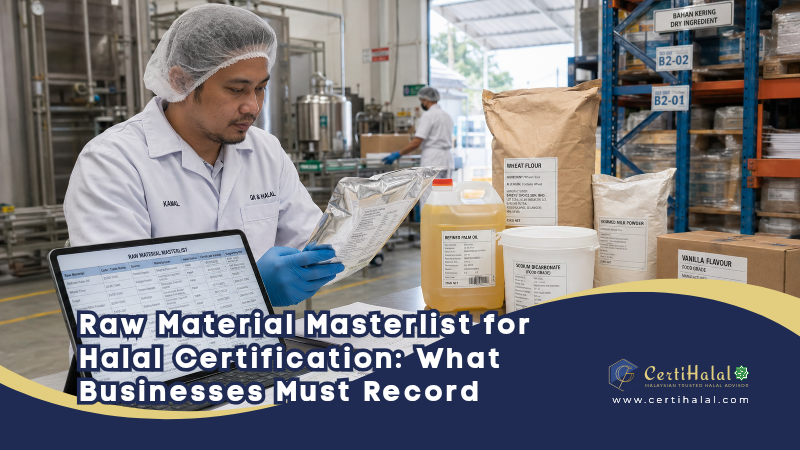
Raw Material Masterlist for Halal Certification: What Businesses Must Record
Published on 13 September 2026Table of Contents
For businesses preparing for Malaysian Halal Certification, the Raw Material Masterlist, known in MHMS 2020 as the Senarai Utama Bahan Mentah, is one of the key records used to demonstrate control over materials entering halal operations.
It is not simply an ingredient spreadsheet.
A properly maintained masterlist helps a business identify what material is being used, who actually manufactures it, where it comes from, what halal or supporting evidence applies to it, and whether the information remains current.
For a business owner, the practical question is:
Can the company prove that the materials being purchased, received, stored and used are the same materials that have been identified and documented within its halal control system?
MHMS 2020 places the Raw Material Masterlist within its requirements for raw material control and requires the list to be accessible for review during Malaysian Halal Certification inspection.
What Is a Raw Material Masterlist?
A Raw Material Masterlist is a controlled record of the raw materials used by a business.
It should not be confused with a recipe, purchasing list, supplier list or the ingredient declaration shown on a finished product.
Those records serve different purposes.
A recipe describes formulation. A supplier list identifies vendors. A product label communicates product information. The Raw Material Masterlist, however, brings together key information needed to identify and support the halal status of materials used in operations.
Depending on the type and size of the business, raw material control may sit within a Halal Assurance System (HAS) or an Internal Halal Control System (IHCS) under MHMS 2020.
What Information Must Businesses Record?
MHMS 2020 states that the Raw Material Masterlist should contain, at minimum, several categories of information for each raw material.
Raw material name
The material should be identified clearly enough that the same item can be recognised across purchasing, receiving, storage and production records.
Vague descriptions may create confusion where several similar ingredients are used.
Scientific name, coding or trade name
Where applicable, the scientific name, internal or manufacturer code, or trade name should also be recorded.
These identifiers help distinguish materials that may have similar common names but different technical specifications or manufacturing sources.
Source of the raw material
MHMS 2020 requires the source of the raw material to be stated.
For business owners, this is especially important where an ingredient’s commercial name does not clearly reveal whether it originates from plant, animal, chemical, microbial or another source.
Materials involving more complex sources may require stronger supporting evidence.
Manufacturer and Supplier Are Not the Same Entity
One of the most important distinctions in raw material documentation is the difference between the manufacturer and the supplier.
The supplier is the party that sells or distributes the material.
The manufacturer is the party that actually produces it.
MHMS 2020 specifically requires the name and address of the raw material manufacturer to appear in the Raw Material Masterlist.
A distributor’s invoice may show who supplied the ingredient, but it does not necessarily establish who manufactured it.
This matters because one supplier may distribute the same type of material from several manufacturers. Halal documentation may also be connected to a specific product, manufacturing source or facility.
For practical control, businesses should therefore avoid treating supplier identity as a substitute for manufacturer identification.
Recording Halal Certificate Information
Where halal certification applies to a raw material, MHMS 2020 requires the masterlist to contain information on the halal certification body and the halal certificate expiry date.
Businesses should therefore be able to connect a raw material record with the relevant halal evidence.
A halal logo appearing on packaging should not be treated as the only basis for verification. The business should be able to establish whether the available certification applies to the material and manufacturer being used and whether the certificate remains within its stated validity period.
As a practical halal-control measure, businesses should also establish a method for identifying certificates approaching expiry. This reduces the risk of outdated documentation remaining unnoticed until an internal audit or certification inspection.
What If a Raw Material Does Not Have a Halal Certificate?
Not every material is documented through a halal certificate in the same way.
MHMS 2020 expressly provides for supporting documents where a raw material does not have a halal certificate. In such cases, information supporting the source of the material should be maintained.
Depending on the material, supporting evidence may include documents such as:
- product specifications;
- process flow information;
- ingredient composition or breakdown;
- Material Safety Data Sheet or Safety Data Sheet;
- Certificate of Analysis;
- Certificate of Origin;
- manufacturer or source information.
The presence of one technical document does not automatically establish halal compliance.
The evidence must be considered in relation to the material itself, its source, composition, manufacturing process and applicable Malaysian Halal Certification requirements.
This distinction is important because the correct principle is not:
No halal certificate means no further action is needed.
It is:
Where halal certification is unavailable, the business still needs adequate evidence to identify and substantiate the material.
Supporting Documents Can Be Referenced Separately
The Raw Material Masterlist does not necessarily need to contain every supporting document within the same file.
MHMS 2020 states that supporting documents kept in separate files should have reference numbers, be properly recorded and remain easy to retrieve.
In practice, the masterlist can therefore function as a controlled index.
For example, a material entry may refer to:
- halal certificate reference;
- product specification reference;
- Certificate of Analysis reference;
- source or process-flow reference.
This approach can make document retrieval more organised during internal review or inspection.
Processing Aids Must Not Be Overlooked
A common mistake is to build the masterlist only from the ingredients printed on the final product label.
MHMS 2020 states that the Raw Material Masterlist should include all raw materials, including processing aids, used by the business.
This means the halal material-control picture can be broader than the consumer-facing ingredient declaration.
A processing aid may be involved in production even if it is not presented to consumers in the same way as a principal ingredient.
[Internal link suggestion: Link to “Halal Processed Food in Malaysia: What Manufacturers Must Control from Formulation to Packaging” using anchor text “halal controls from formulation to packaging”]
The Masterlist Must Connect With Purchasing, Receiving and Storage
A complete masterlist is useful only if business operations follow the information recorded in it.
MHMS 2020’s raw material control procedure covers purchasing, receiving and storage. It also requires relevant records to be maintained.
During purchasing, the business should ensure that the material being ordered corresponds with its established raw material controls.
During receiving, staff should verify the incoming material and supporting information. MHMS 2020’s example procedure specifically refers to ensuring that packaging information allows the actual manufacturer and halal status to be identified.
This creates an operational chain:
documented material → purchase → delivery → receiving verification → storage → production
Supporting records may include Purchase Orders, Delivery Orders, invoices, incoming-material records and stock records.
Changes Should Trigger Review
Raw material information does not remain static forever.
Changes may involve:
- the raw material itself;
- manufacturer;
- supplier;
- formulation;
- source;
- code or trade name;
- halal certificate;
- supporting documentation.
MHMS 2020 requires the Raw Material Masterlist to be updated when raw material information changes.
It also assigns internal halal-management responsibilities for verifying changes involving raw materials, suppliers, products and processes.
As a practical business control, changes should therefore be reviewed before an alternative material is allowed to enter routine use.
Two technically similar ingredients should not automatically be assumed to have identical halal documentation.
The Masterlist Must Match Actual Production
A well-maintained record should reflect what is physically used.
If the masterlist identifies a material from one manufacturer while production is using material from another manufacturer, the business has a documentation and operational-control gap.
The same principle applies to warehouse stock.
Material names, manufacturer details and other identifying information should be capable of being cross-checked against actual packaging and records.
This is one reason internal halal audits should include both documentary review and physical verification.
MHMS 2020’s sample internal audit checklist includes checking whether halal certificates remain valid, whether materials used are the same as those declared, whether manufacturers can be identified, and whether changes to ingredients or manufacturers are known.
How the Masterlist Supports Traceability
The Raw Material Masterlist supports traceability, but it is not a complete traceability system by itself.
MHMS 2020 defines traceability as the ability to identify and track raw materials and products through stages including receiving, processing, storage and distribution.
The masterlist contributes controlled reference information about the materials involved.
A practical traceability chain may connect:
raw material → manufacturer → supplier → receiving record → production batch → finished product → distribution record
A useful business test is:
If a problem with a raw material is discovered today, can the company determine where that material was used?
Common Raw Material Masterlist Mistakes
Businesses should watch for recurring weaknesses such as:
- recording only the supplier and not the manufacturer;
- omitting processing aids;
- keeping expired halal certificates without review;
- using inconsistent material names across departments;
- failing to link supporting evidence with individual material records;
- allowing material substitutions without halal review;
- leaving obsolete materials active on the list;
- failing to update manufacturer or source information;
- having warehouse stock that does not match documented information;
- being unable to retrieve supporting documents when required.
These weaknesses usually indicate that documentation and actual operations are no longer fully aligned.
[Internal link suggestion: Link to “Why Businesses Struggle with Halal Certification — And How to Get It Right” using anchor text “common halal certification problems”]
A Practical Raw Material Control Workflow
For business owners, the process can be understood as:
Identify → verify → document → review → purchase → receive → use → trace → monitor → audit
First, identify every relevant raw material and processing aid.
Next, establish the source and actual manufacturer, then obtain the applicable halal certificate or supporting documentation.
Record the information in the masterlist and reference supporting evidence in an organised manner.
Purchasing and receiving controls should then help prevent unintended substitutions.
Finally, the business should review changes, monitor document validity and verify the system through internal halal auditing.
The result is not merely a completed spreadsheet. It is a controlled connection between documentation and actual business operations.
Preparing the Masterlist for Halal Certification Inspection
Before inspection, businesses should reconcile the Raw Material Masterlist against three areas.
Current formulations: confirm that the materials used in recipes or manufacturing records correspond with documented information.
Current warehouse stock: check that actual packaging and manufacturer information match the records.
Current supporting evidence: make sure relevant certificates, specifications and technical documents can be retrieved and remain current where applicable.
The goal is to demonstrate that the company’s halal documentation accurately reflects its operations.
Raw Material Control Continues After Certification
Raw material control does not end once halal certification has been obtained.
New ingredients may be introduced. Manufacturers may change. Suppliers may replace products. Supporting documents may be updated and halal certificates may expire.
The Raw Material Masterlist should therefore remain a current control record rather than a historical application document.
Maintaining it properly supports wider halal-management activities including purchasing control, traceability, internal auditing and future certification review.
Frequently Asked Questions
1. Is a Raw Material Masterlist required for Malaysian Halal Certification?
MHMS 2020 requires businesses subject to raw material control requirements to establish a Raw Material Masterlist that can be referred to during Malaysian Halal Certification inspection.
2. Is the Raw Material Masterlist the same as an ingredient list?
No. An ingredient list describes product ingredients, while the Raw Material Masterlist contains broader control information such as material identity, source, manufacturer and relevant halal or supporting documentation.
3. What information must be included?
MHMS 2020 identifies the raw material name, scientific name/coding/trade name, source, manufacturer’s name and address, declaration status, halal certification information, supporting documents and remarks as minimum information.
4. Do processing aids need to be included?
Yes. MHMS 2020 states that the masterlist should cover all raw materials, including processing aids used by the business.
5. Should businesses record the supplier or manufacturer?
Manufacturer information is specifically required in the masterlist. Supplier information is also operationally useful, but the supplier and manufacturer should not be treated as the same entity unless they genuinely are the same party.
6. Does every raw material need a halal certificate?
Not every material is documented through a halal certificate in the same way. MHMS 2020 allows supporting source documentation to be recorded where a material does not have a halal certificate. Whether that evidence is sufficient depends on the material and the applicable halal-certification requirements.
7. What should happen when a halal certificate expires?
An expired certificate should trigger a review of the material’s halal documentation and continued use under the company’s applicable halal-control procedure. Businesses should not assume that previously verified documentation remains current after expiry.
8. What should happen when a manufacturer changes?
The change should be reviewed because manufacturer identity forms part of the masterlist information. Relevant halal or supporting evidence should be checked and the masterlist updated before the new information becomes part of routine control.
9. Can the Raw Material Masterlist be digital?
Yes. MHMS 2020 states that the masterlist may be maintained in digital or printed form, provided it is accessible and can be reviewed.
10. What will an internal halal auditor compare against the masterlist?
Internal audit checks can include whether raw materials used match declared information, whether the manufacturer can be identified, whether halal certificates remain valid, and whether changes involving raw materials or manufacturers have been properly recognised.
Conclusion
The Raw Material Masterlist should be treated as a central component of raw material control, not as a spreadsheet completed only for a certification application.
For business owners, its real value is the connection it creates between material identity, source, manufacturer, halal evidence, purchasing, receiving, production and traceability.
When those elements remain aligned, the business is in a much stronger position to show that its documented halal controls reflect the materials actually entering and being used in its operation.
That is what makes the Raw Material Masterlist useful for halal certification: it turns raw material information into a record that can be checked, maintained and verified against actual business practice.
Disclaimer:
This content is for informational purposes only and does not constitute legal or regulatory advice. Halal certification decisions are subject to the requirements and approval of Jabatan Kemajuan Islam Malaysia and relevant authorities.