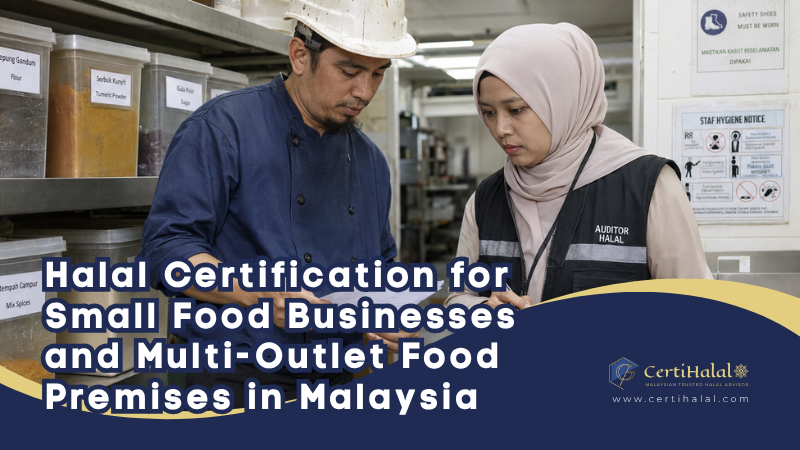
Halal Certification for Small Food Businesses and Multi-Outlet Food Premises in Malaysia
Published on 26 May 2026Table of Contents
Introduction
Halal certification in Malaysia is not only about displaying a certificate or using the word “halal” in marketing. For food businesses, it is a structured compliance process that requires proper control over ingredients, suppliers, preparation methods, storage, documentation, and customer-facing claims.
However, the level of halal control required may differ depending on the size and complexity of the business. A small food business with one kitchen faces different operational risks compared with a food premises chain operating several branches, a central kitchen, and multiple outlet teams.
This is why business owners should understand the difference between the Internal Halal Control System (IHCS) and the Halal Assurance System (HAS) under the Malaysian Halal Management System 2020, commonly referred to as MHMS 2020. In general, IHCS applies to smaller and micro businesses, while HAS is required for larger and more structured operations.
Halal certification should therefore be viewed as a business compliance system, not just a marketing advantage. As a food business grows, its halal controls must also become more organised, consistent, and evidence-based.
Why Halal Certification Requirements Change as a Food Business Grows
A small food business is usually easier to monitor. The owner may be directly involved in purchasing ingredients, preparing food, checking supplier documents, and managing daily operations. There may be fewer workers, fewer recipes, and fewer storage areas.
A multi-outlet food premises is more complex. It may involve a head office, central kitchen, outlet managers, branch-level staff, purchasing teams, delivery arrangements, and different preparation areas. Even if the same menu is used across all outlets, halal risk may arise when one outlet changes ingredients, buys from an unapproved supplier, or fails to follow the approved preparation process.
This means halal certification is not one-size-fits-all. As a food business grows, halal compliance must move from basic control to a more structured assurance system. The business must prove not only that the food is halal, but that the halal process is consistently controlled.
Small Operators Have More Direct Control
For a small café, stall, kiosk, or single-location food business, halal control is usually close to the owner or manager. Decisions about ingredients, suppliers, food preparation, and storage can often be monitored directly.
This does not mean the process is simple, but the control structure is usually more straightforward. The main priority is to ensure that every ingredient, supplier, preparation method, and record can be properly verified.
Larger Food Premises Require System-Wide Governance
For a multi-outlet business, halal control cannot depend only on one person’s supervision. The business must create a system that can be repeated across branches.
This includes standard operating procedures, approved supplier controls, outlet-level staff training, internal halal audits, and proper documentation for each relevant premises.
Growth Increases Halal Risk Exposure
As the number of outlets, staff, suppliers, and menu items increases, the possibility of inconsistency also increases. A single weak branch can affect the credibility of the overall halal system.
This is why growing food businesses need stronger halal governance before problems arise. Halal compliance must be managed as part of daily operations, not only during the certification application stage.
What Small Food Businesses Need to Prepare
For smaller food businesses, the focus is usually on building a practical Internal Halal Control System. The requirement is not less important, but the system is more focused compared with a full Halal Assurance System for larger businesses.
The key areas usually include a clear halal policy, control over raw materials, verification of supplier halal certificates, basic halal risk control, traceability of ingredients and products, and proper documentation.
The business should be able to show where its ingredients come from, whether suppliers are approved, whether halal certificates are valid, and how ingredients are stored and used.
Ingredient and Supplier Verification
A small food business should not rely only on verbal assurance from suppliers. It should keep updated records of ingredient sources, product specifications, halal certificates, invoices, delivery orders, and any ingredient changes.
For example, if a café changes its sauce supplier or introduces a new topping, the halal status of that new ingredient should be checked and recorded before use.
Basic Documentation and Record-Keeping
Proper documentation is one of the most common weak points among small food operators. Even when the food itself appears compliant, missing records can delay certification or create uncertainty during inspection.
Important records may include halal certificates, supplier details, product specifications, invoices, delivery orders, ingredient lists, and simple traceability records.
Practical Halal Control Without Overcomplication
The purpose of IHCS is to help smaller operators maintain halal control in a simple but documented way. The business does not need to overcomplicate the system, but it must be able to prove that halal compliance is managed consistently.
A practical system is better than an impressive-looking file that does not reflect daily operations.
What Multi-Outlet Food Premises Need to Control
For multi-outlet food premises, halal certification becomes more system-driven. The main issue is not only whether a single kitchen is compliant, but whether the entire network of outlets follows the same approved halal controls.
Under MHMS 2020, food premises chains are subject to more structured requirements. For chain food premises, the business is expected to implement HAS comprehensively, appoint a Halal Executive at management or central kitchen level, involve the operations manager in the internal halal committee, prepare HAS documents for inspection, conduct internal halal audits across the chain premises, and maintain a list of premises under the same brand or ownership.
This means a multi-outlet operator must pay close attention to central kitchen control, outlet-level compliance, standardised recipes, approved supplier lists, approved menu items, staff training across branches, internal halal audit records, traceability across outlets, and clear documentation for every certified or applying premises.
The risk is higher because a single weak branch can undermine confidence in the overall operation. If the head office has proper documentation but outlet staff do not understand halal procedures, the system may still fail during inspections or in daily practice.
Central Kitchen and Outlet-Level Control
For businesses with a central kitchen, halal control must cover both centralised preparation and branch-level handling. Ingredients may be prepared at one location but stored, reheated, assembled, or served at another.
Each stage must be controlled so that halal integrity is maintained from preparation to final service.
Standardised Recipes and Approved Suppliers
Multi-outlet businesses should use standardised recipes and approved supplier lists. Outlet staff should not change ingredients or purchase substitutes independently, even during stock shortages.
Any ingredient or supplier change should go through proper review and approval before use. This helps prevent unapproved materials from entering the halal production or service process.
Internal Halal Audits Across Branches
Internal halal audits are important because they help the business detect weaknesses before they become serious compliance issues. Audits should not only check documents at head office. They should also assess how halal procedures are followed at outlet level.
This is especially important for food premises chains where daily operations may differ slightly from one branch to another.
The Real Difference Between IHCS and HAS
The biggest difference between a small food business and a multi-outlet food premises is the depth of governance.
A small business primarily needs to demonstrate that its food preparation is halal-controlled. A multi-outlet business must prove that its operating system is halal-controlled.
For a small food business, the business owner or manager may directly supervise purchasing, storage, and preparation. The control is closer to the daily operation.
For a multi-outlet business, control must be delegated but still standardised. The head office or central kitchen cannot simply assume that every outlet follows the correct procedure. It must create a system that makes compliance repeatable.
This includes clear SOPs, outlet training, supplier controls, regular internal audits, and corrective action when problems are found.
Small Business Halal Control
Small business halal control is mainly about readiness and discipline. The business must be able to show that ingredients, suppliers, preparation areas, storage practices, and records are properly managed.
The system should be simple enough to operate daily, but strong enough to support certification inspection.
Multi-Outlet Halal Assurance
Multi-outlet halal assurance is about governance and consistency. The business must be able to show that halal compliance is not dependent on one outlet manager or one kitchen team.
Every outlet should follow the same approved system, and the company should have records to prove this.
Same Goal, Different Scale of Evidence
Both small and larger food businesses must prove halal integrity. The difference is the scale of evidence required.
A small food business may need simpler records and direct controls. A multi-outlet food premises needs broader documentation, stronger internal coordination, and evidence that the same halal standards are applied across all relevant locations.
Compliance Areas That Apply to Both Small and Larger Food Operators
Although the level of system control differs, both small and larger food businesses must take halal compliance seriously.
The most important shared compliance area is raw material control. Ingredients such as meat, poultry, dairy, gelatine, emulsifiers, flavourings, enzymes, shortening, margarine, sauces, and processing aids may carry halal risk if their source is unclear or if supporting documents are incomplete.
A good food business should maintain a proper Raw Material Masterlist. This list should identify the ingredient name, supplier, source, halal certificate status, expiry date, and supporting documents.
Raw Material Control
Raw material control should cover purchasing, receiving, storage, and usage. A business should know exactly which ingredients are approved, where they come from, and whether the supporting documents are still valid.
This is especially important when ingredients are imported, repacked, processed, or supplied through multiple intermediaries.
Traceability of Ingredients and Products
Traceability is also important. A food business should be able to trace where ingredients came from and how they were used.
For larger operations, traceability may also involve batch records, outlet stock movement, production logs, and mock recall procedures.
Careful Use of Halal Claims
Customer-facing halal claims must be handled carefully. A business should avoid giving misleading impressions about halal status.
If only some outlets or products are certified, this should be communicated clearly. If certification is still in progress, the business should not present itself as already certified.
Common Mistakes That Can Delay or Weaken Halal Certification
Many food businesses face halal certification delays not because their products are intentionally non-compliant, but because their documentation and internal controls are weak.
Common mistakes include using ingredients without updated halal certificates, failing to track certificate expiry dates, changing suppliers without records, allowing outlet-level staff to buy ingredients independently, and not keeping proper invoices or delivery orders.
Incomplete Supplier and Ingredient Records
One of the most common problems is incomplete supplier documentation. A business may know who supplies the ingredient, but may not have the necessary halal certificate, product specification, or supporting document to verify the ingredient properly.
This creates uncertainty during certification preparation and inspection.
Uncontrolled Ingredient Changes
Ingredient changes can create halal risk if they are not reviewed. Even a small change in sauce, seasoning, flavouring, margarine, shortening, or topping may affect halal status.
For multi-outlet food premises, this risk becomes greater when individual branches make their own purchasing decisions.
Inconsistent Branch Practices
For multi-outlet food premises, one common problem is inconsistent branch practice. The head office may have an approved supplier list, but an outlet may use a different product because of stock shortage.
A central kitchen may follow the approved recipe, but an outlet may change toppings, sauces, or preparation methods without approval.
Treating Halal as Marketing Instead of Compliance
Another common issue is treating halal as a marketing claim instead of a compliance responsibility. Halal certification is not just about customer perception. It is a formal system of control, evidence, and accountability.
Businesses that understand this are better prepared for certification and long-term compliance.
Building Customer Trust Through Clear Halal Assurance
Halal certification is ultimately about trust. Muslim consumers want confidence that the food they consume has been prepared, handled, and served according to recognised halal requirements.
For small businesses, trust is built through honest communication, clean operations, proper ingredient control, and readiness for inspection.
For multi-outlet food premises, trust depends on consistency. Customers expect the same halal confidence whether they visit one branch or another. This requires strong internal governance, well-trained staff, and clear outlet-level compliance.
A good halal system protects the business as much as it protects the customer. It reduces confusion, prevents risky shortcuts, supports certification renewal, and strengthens long-term brand credibility.
Conclusion
Halal certification in Malaysia should not be treated as a one-time application or a simple branding exercise. For food businesses, it is a continuing responsibility that requires proper control over ingredients, suppliers, preparation methods, staff practices, documentation, and customer-facing claims.
Small food businesses need a practical halal control system that helps them manage ingredients, suppliers, records, and traceability without unnecessary complexity. Multi-outlet food premises need a stronger assurance system that ensures consistency across branches, central kitchens, outlet teams, and operational records.
The key difference is not the importance of halal compliance, but the level of governance required. As a business grows, its halal system must also grow.
Whether a business is small or operating across many outlets, the goal remains the same: to maintain halal integrity from ingredient sourcing to final service. Businesses that prepare early, document properly, and manage halal compliance as part of daily operations will be in a stronger position to achieve certification, maintain consumer trust, and support long-term growth.
FAQ
1. What is the difference between halal certification for a small food business and a multi-outlet food premises?
The main difference is the level of control required. A small food business usually focuses on basic halal control over ingredients, preparation, storage, and records. A multi-outlet food premises must prove that halal compliance is applied consistently across all branches, staff teams, kitchens, suppliers, and documentation systems.
2. What is IHCS in halal certification?
IHCS stands for Internal Halal Control System. It is a basic halal control system generally used by small and micro businesses. It focuses on halal policy, raw material control or halal risk control, and traceability.
3. What is HAS in halal certification?
HAS stands for Halal Assurance System. It is a more comprehensive halal management system used by larger or more complex businesses. It may involve a Halal Executive, internal halal committee, internal halal audit, risk control, raw material control, training, traceability, and management review.
4. Why do multi-outlet food premises need stronger halal controls?
Multi-outlet food premises have more operational layers. Different branches may have different staff, storage areas, preparation routines, and stock handling practices. Stronger halal controls are needed to ensure that every outlet follows the same approved system.
5. Does every outlet need to follow the same halal procedures?
Yes. For a food premises chain, every outlet should follow the approved halal procedures. This includes using approved ingredients, approved suppliers, standard recipes, proper storage practices, trained staff, and updated records.
6. What documents are important for halal certification readiness?
Important documents include halal policy, supplier halal certificates, Raw Material Masterlist, approved supplier list, product or menu list, SOPs, training records, audit records, traceability records, and corrective action records.
7. What is a Raw Material Masterlist?
A Raw Material Masterlist is a structured record of all ingredients and materials used by the business. It helps identify ingredient names, suppliers, sources, halal certificate status, expiry dates, and supporting documents.
8. What are common halal risks in food businesses?
Common risks include unclear ingredient sources, expired halal certificates, unapproved suppliers, undocumented recipe changes, poor storage separation, shared equipment issues, cross-contamination risk, and incomplete traceability records.
9. Can a business claim it is halal before certification is approved?
A business should be careful with halal-related claims before certification is approved. Claims such as “halal-certified” should only be used when the relevant certification has been properly obtained. Misleading claims may damage customer trust and create compliance concerns.
10. How can a food business reduce delays in halal certification?
A business can reduce delays by preparing documents early, checking supplier halal certificates, maintaining raw material records, training staff, reviewing SOPs, and ensuring that daily operations match the documents submitted. For multi-outlet businesses, each branch should also be checked before inspection.
Disclaimer:
This content is for informational purposes only and does not constitute legal or regulatory advice. Halal certification decisions are subject to the requirements and approval of Jabatan Kemajuan Islam Malaysia and relevant authorities.