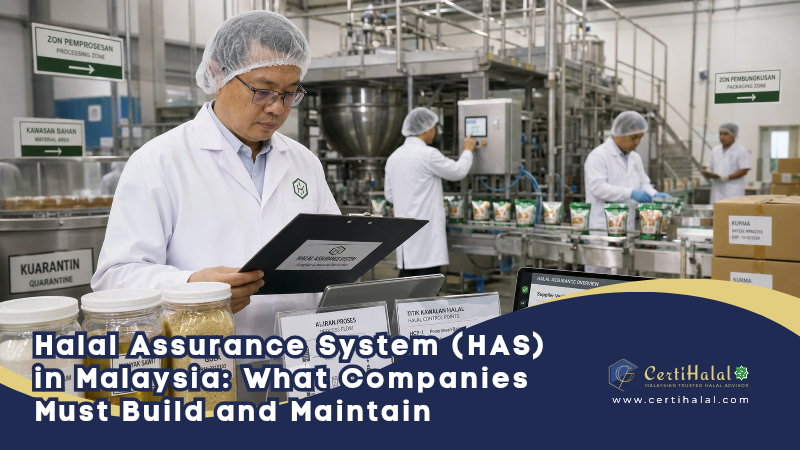
Halal Assurance System (HAS) in Malaysia: What Companies Must Build and Maintain
Published on 12 September 2026Table of Contents
For businesses pursuing Malaysia Halal Certification, the Halal Assurance System (HAS) is not simply a file prepared for inspection. It is the internal management system that helps a company organise responsibilities, control halal risks, verify materials, maintain traceability, detect weaknesses and keep its halal practices effective over time.
Under the Malaysian Halal Management System (MHMS 2020), companies are responsible for developing, implementing and maintaining the appropriate internal halal control system. Depending on the applicable industry category and certification scheme, this may involve either a Halal Assurance System (HAS) or an Internal Halal Control System (IHCS).
For business owners, the practical question is therefore not only, “What documents do we need for halal certification?” It is:
What must the company build internally, how must it operate, and what must be maintained after certification is granted?
Where HAS Fits Within Malaysia’s Halal Management Framework
MHMS 2020 provides the management framework for internal halal control in Malaysia. Within this framework, businesses implement either HAS or IHCS according to the relevant requirements.
Medium and large industries are generally required to implement HAS under the applicable certification schemes, while small and micro industries generally implement IHCS. However, businesses should not rely on company size alone. The specific requirements depend on the certification scheme, type of premises and nature of the operation.
MHMS 2020 should also be read together with the relevant Malaysia Halal Certification procedures, Malaysian Standards, fatwa, legislation, regulations and halal certification circulars.
This matters because a food manufacturer, hotel, logistics operator, slaughterhouse or contract manufacturer may face different scheme-specific requirements even though all operate within the same wider halal certification framework.
Start With Clear Halal Governance
A functioning HAS begins with management responsibility.
Top management is expected to provide sufficient resources and support for halal management. HAS should not be treated as the responsibility of one employee acting alone.
A company implementing HAS generally needs three core governance elements:
- a documented Halal Policy;
- a qualified Halal Executive;
- an Internal Halal Committee, or Jawatankuasa Halal Dalaman (JKHD).
Under the general HAS requirements, JKHD should include at least a chairperson, the Halal Executive, a purchasing or procurement representative and a processing representative. Additional members may be required according to the certification scheme.
The committee must also function in practice. MHMS 2020 requires JKHD meetings to be conducted at least twice a year, with halal matters discussed and the relevant records maintained.
For a business owner, this structure is important because halal risks can be created by decisions in procurement, production, R&D, operations, warehousing or logistics.
Appoint the Right Halal Executive
The Halal Executive is not merely an administrative contact for a certification application.
MHMS 2020 defines specific competency and appointment requirements for the role. These include being Muslim, holding Malaysian citizenship subject to the relevant certification procedure, being permanently employed and meeting the required qualification or halal-management experience criteria. The person must also hold the relevant Halal Executive certification from a registered training provider.
The Halal Executive is responsible for coordinating halal management, maintaining HAS documentation, supporting the Internal Halal Committee and ensuring that the system is properly implemented.
This makes the role a dedicated compliance function rather than an informal extra duty assigned without authority or competence.
Build a HAS Manual That Matches the Real Operation
The HAS Manual is one of the central documents in the system, but its value depends on whether it reflects what the company actually does.
MHMS 2020 requires the manual to be developed according to the company’s real operations, updated when the implementation changes and approved by top management. It must also be documented separately from other management or certification systems.
At minimum, the HAS Manual should include:
- company profile;
- objectives and scope;
- Halal Policy;
- Internal Halal Committee;
- Internal Halal Audit procedure;
- halal risk control procedure;
- raw material control procedure;
- halal training procedure;
- traceability procedure;
- HAS Review procedure;
- laboratory analysis procedure;
- sertu procedure.
Each procedure should also carry appropriate document-control information such as effective date, revision date, preparation and approval details.
A common weakness occurs when the written HAS procedure says one thing while employees follow a different process in practice.
Treat Halal Risk Separately From Food-Safety Risk
A company may already operate HACCP, GMP, MeSTI or another management system. These controls can support operational discipline, but they do not replace halal risk control.
MHMS 2020 requires halal risk control to be developed specifically for halal risk and separated from other certification systems.
The company should consider halal risks across areas such as:
- R&D and formulation;
- products, menus and services;
- processing;
- premises and equipment;
- employees;
- packaging;
- storage;
- transportation.
The objective is to identify where halal integrity could be affected and create controls before a problem occurs.
Identify Halal Control Points
A Halal Control Point, or HCP, is a point at which halal risk must be identified and controlled so that contamination or non-compliance can be prevented or eliminated.
Under MHMS 2020, HCP determination should be based on the actual process flow and relevant floor layout.
For example, an HCP may exist during:
- ingredient approval;
- purchasing;
- receiving;
- processing;
- storage;
- cleaning;
- transport.
A proper Halal Risk Management Plan should connect each HCP to:
halal risk → control method → monitoring frequency → responsible person → corrective action → record
This is what turns HAS from policy into a working control system.
Control Raw Materials Before They Enter Production
Raw material control is one of the most important parts of HAS.
The company must establish written procedures covering purchasing, receiving and storage. Materials should be verified against approved information before use.
A Raw Material Masterlist should be maintained as a controlled reference. Depending on the material, it can include:
- material name;
- scientific, coding or trade name;
- source;
- manufacturer;
- manufacturer address;
- declaration status;
- halal certification body;
- certificate expiry date;
- supporting documents;
- remarks.
The masterlist must also include processing aids used in the operation and should be updated when material information changes.
Not every material is necessarily controlled through a halal certificate alone. Where a halal certificate is required or relied upon, its validity and certification body should be verified. Where a material does not have a halal certificate, appropriate supporting documentation identifying its source should be maintained.
Control Changes to Ingredients and Suppliers
A previously approved material should not automatically remain approved when something changes.
Changes involving:
- supplier;
- manufacturer;
- formulation;
- raw material source;
- product specification;
- processing aid;
may affect the original halal assessment.
The company should therefore have a change-control process that requires halal review, documentation updates and, where applicable, declaration to the competent halal authority.
For a business owner, this is one of the clearest examples of why HAS must be maintained continuously rather than prepared only for inspection.
Build Traceability From Supplier to Customer
A working traceability system should allow the company to identify where a material came from and where the finished product went.
In practical terms, the company should be able to trace one step backward to the source of a material and one step forward to the destination of the finished product.
Relevant evidence may include:
- purchase orders;
- delivery orders;
- invoices;
- stock records;
- halal certificates;
- product specifications;
- Certificates of Analysis;
- production records;
- batch or lot numbers;
- distribution records.
If a halal non-conformance occurs, this information helps the business identify affected products, quarantine stock and decide whether withdrawal or recall is necessary.
Companies required to implement HAS must also conduct a mock recall at least once a year to test whether the traceability system works effectively.
[Internal link suggestion: Link to “Halal Food Supply Chain in Malaysia: How Businesses Can Protect Halal Integrity from Farm to Table” using anchor text “halal supply chain traceability”]
Train Employees According to Their Responsibilities
HAS depends on competent people.
MHMS 2020 requires halal awareness and competency training according to the employees’ responsibilities.
Relevant new employees should receive halal awareness training within three months of appointment. Halal awareness training for employees involved in processing or services must also be conducted periodically, while members of JKHD require competency training covering relevant halal certification requirements.
A company should maintain a training plan showing:
- training type;
- participants;
- frequency;
- proposed date;
- trainer;
- records.
Training should therefore be treated as operational competency, not simply as certificates stored in a file.
Use Internal Halal Audits to Detect Weaknesses
Internal halal audits test whether the company is actually following its HAS procedures.
The general MHMS 2020 requirement is for an internal halal audit to be conducted at least once a year for each relevant branch or premises network.
The audit should cover relevant certification requirements and HCPs and may examine:
- documentation;
- raw materials;
- employees;
- processing;
- equipment;
- packaging;
- storage;
- transportation.
Internal halal auditors must also meet the applicable competency requirements and be formally appointed.
When a non-conformance is identified, the company should take corrective action promptly, document the action and verify its effectiveness.
The purpose is not merely to record problems. It is to prevent the same weakness from recurring.
Review Whether HAS Is Still Effective
Internal Halal Audit and HAS Review are related but different.
An Internal Halal Audit asks:
Are the procedures and controls being followed?
A HAS Review asks:
Is the overall halal management system still effective?
MHMS 2020 requires HAS Review at least once a year. It should evaluate the effectiveness of HAS and the capability and effectiveness of the Internal Halal Committee. The review must involve JKHD and top management and be formally confirmed.
This is where management can consider:
- recurring audit findings;
- changes in suppliers;
- material changes;
- new products;
- process changes;
- new premises;
- staffing changes;
- weaknesses in controls.
Prepare Laboratory Analysis and Sertu Procedures
HAS also includes supporting controls for situations where additional verification or corrective action may be required.
Where relevant, companies should maintain a laboratory-analysis procedure, particularly for halal-critical materials or products. MHMS 2020 identifies possible analysis areas such as meat species identification, alcohol, proteins, fats and oils.
A written sertu procedure should also be available as preparation for contamination involving najis mughallazah. The procedure should follow the applicable JAKIM guidance and MAIN or JAIN requirements.
The important point is preparedness: these procedures should exist before an incident occurs.
Maintain Records as Evidence of Compliance
HAS records are evidence that the company’s controls have actually been implemented.
These may include:
- halal certificates;
- supplier documents;
- Raw Material Masterlists;
- purchasing and receiving records;
- audit reports;
- corrective-action records;
- JKHD meeting minutes;
- training records;
- traceability records;
- mock recall records;
- HAS Review records;
- laboratory-analysis records;
- sertu records.
MHMS 2020 requires relevant documentation and records to be kept updated and generally retained for at least three years. New applicants should also have at least three months of records available for certification inspection.
The practical lesson for business owners is straightforward:
records should be generated through normal operations, not reconstructed shortly before an audit.
HAS Must Continue After Certification
Halal certification does not remove the need for internal control.
After certification, businesses continue to change. New products are introduced, suppliers are replaced, employees join, equipment changes and new logistics arrangements may be made.
Each significant change should trigger a halal question:
Does this change affect an existing halal risk, HCP, approval, procedure or record?
A mature HAS therefore operates as a continuous cycle:
build → implement → record → audit → correct → review → update → maintain
Maintaining this cycle helps the company demonstrate that its halal controls remain effective during certification, monitoring and renewal activities.
Frequently Asked Questions About HAS in Malaysia
1. What is a Halal Assurance System?
A Halal Assurance System is a structured set of procedures used by an organisation to maintain halal assurance comprehensively under Malaysia’s halal management framework.
2. Which companies need HAS instead of IHCS?
Medium and large industries generally implement HAS under the relevant certification schemes, while small and micro industries generally implement IHCS. The final requirement depends on the applicable certification scheme and premises category.
3. Can HACCP, GMP or MeSTI replace HAS?
No. These systems may support operational control, but MHMS 2020 requires halal risk control to be developed specifically for halal risks and separately from other certification systems.
4. What must a HAS Manual contain?
It should include the company profile, objectives and scope, Halal Policy, Internal Halal Committee and the required procedures covering internal audit, halal risk, raw materials, training, traceability, HAS Review, laboratory analysis and sertu.
5. Who manages HAS inside the company?
Top management provides commitment and resources, the Halal Executive coordinates halal management and the Internal Halal Committee helps develop, implement, monitor and review the system.
6. Does every raw material need a halal certificate?
Not necessarily. Where halal certification is required or relied upon, it should be valid and appropriately recognised. Materials without halal certificates may require supporting documentation that clearly identifies their source and status.
7. What should a company do when a supplier or ingredient changes?
The change should be reviewed before continued use. Relevant approvals, supporting documents, the Raw Material Masterlist and other HAS records should be updated, with any required declaration made to the competent halal authority.
8. How often must internal halal audits and HAS Reviews be conducted?
Under the general MHMS 2020 requirements, both should be conducted at least once a year. Internal audits apply to each relevant branch or premises network, while HAS Review involves JKHD and top management.
9. What is the purpose of a mock recall?
A mock recall tests whether the company can trace affected materials and products through its supply chain and respond effectively if a halal non-conformance or contamination occurs.
10. How long must HAS records be retained?
Relevant HAS documentation and records should generally be retained for at least three years. For a new application, at least three months of records should be available for certification inspection.
Disclaimer:
This content is for informational purposes only and does not constitute legal or regulatory advice. Halal certification decisions are subject to the requirements and approval of Jabatan Kemajuan Islam Malaysia and relevant authorities.