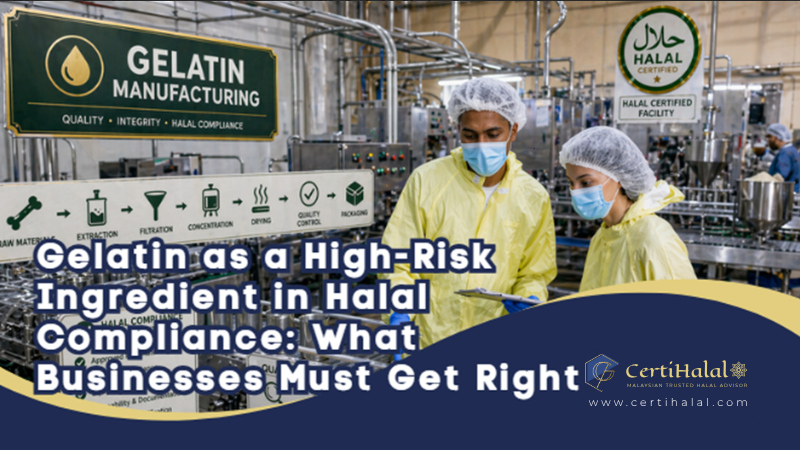
Gelatin as a High-Risk Ingredient in Halal Compliance: What Businesses Must Get Right
Published on 30 April 2026Table of Contents
Gelatin is often treated as a routine ingredient across food, pharmaceuticals, and consumer products. However, from a halal compliance perspective, it is one of the most sensitive and high-risk components in the entire supply chain.
Many businesses assume that reviewing an ingredient list is sufficient to determine compliance. In reality, regulatory authorities evaluate far more than just the ingredient name. They assess the origin, processing methods, handling procedures, and supporting documentation behind each material. This is where gelatin frequently becomes a critical point of failure.
Understanding how to manage gelatin correctly is essential for any organisation seeking halal certification or planning to enter regulated halal markets.
Why Gelatin Is a High-Risk Ingredient
Gelatin is derived from collagen, typically extracted from animal tissues such as skin and bones. This origin introduces complexity, as its halal status depends heavily on both the source animal and the processing method.
The primary risk lies in the source itself. If gelatin is derived from prohibited animals, it is automatically non-compliant. Even when sourced from permissible animals, the method of slaughter must meet specific requirements to be considered acceptable.
Processing adds another layer of complexity. Some businesses assume that transformation during processing eliminates concerns related to the source. However, this assumption is not consistently accepted by regulatory authorities.
Because of these factors, gelatin is classified as a high-risk ingredient that requires closer scrutiny than standard raw materials.
Halal Compliance Requirements for Gelatin
Ensuring gelatin meets halal standards requires a structured approach across several key areas.
The first step is verifying the source. Businesses must clearly identify and confirm the origin of the gelatin, including the animal species, whether the source is permissible, and how the animal was processed. Without clear verification, the ingredient may be classified as doubtful or non-compliant.
Slaughter compliance is equally important. For animal-derived gelatin to be acceptable, the slaughter process must follow established guidelines. This ensures that the product aligns with the underlying principles governing permissible consumption.
Processing integrity must also be controlled. Manufacturing environments must prevent contamination with non-halal substances through proper cleaning procedures, equipment segregation, and controlled production conditions. Even minor contamination can compromise the entire batch.
Documentation is one of the most critical elements. Businesses must maintain complete and verifiable records, including certificates of origin, supplier declarations, and process documentation. Compliance is not based on assumptions — it must be supported by evidence.
Regulatory Expectations and Certification Standards
Regulatory authorities apply strict standards when evaluating high-risk ingredients such as gelatin. Their focus extends beyond the ingredient itself to include the entire supply chain and production system.
In Malaysia, the Department of Islamic Development Malaysia plays a central role in assessing compliance. This includes reviewing documentation, verifying sourcing, and ensuring that manufacturing processes meet required standards.
For businesses targeting Indonesia, compliance must align with the requirements set by the Halal Product Assurance Organizing Agency. This authority oversees market entry requirements and ensures products meet national regulations.
Across different jurisdictions, expectations remain consistent. Authorities require full traceability of ingredients, clear documentation of sourcing and processing, and demonstrated control over production systems. High-risk ingredients such as gelatin receive additional scrutiny, and any inconsistencies can result in delays or rejection.
Supply Chain and Traceability Management
Effective gelatin compliance begins with strong supply chain control.
Supplier qualification is a critical first step. Businesses must carefully evaluate and approve suppliers to ensure they provide complete documentation, maintain consistent standards, and understand halal requirements. Selecting the wrong supplier can introduce risks that are difficult to correct later.
Traceability systems are equally important. Companies must be able to track gelatin from its origin through to the final product. This includes batch tracking, source identification, and movement across facilities. Without traceability, demonstrating compliance during audits becomes nearly impossible.
Contamination control is another key area. Manufacturing processes must prevent cross-contamination through proper cleaning procedures, segregation measures, and equipment control. Even a small lapse can invalidate an otherwise compliant product.
Documentation must flow consistently across the entire supply chain. From supplier to manufacturer, every stage must be recorded and accessible. Missing or inconsistent documentation is one of the most common causes of audit failure.
Common Compliance Failures in Gelatin Usage
Despite best efforts, many businesses encounter recurring issues when managing gelatin.
One of the most common problems is the use of unknown or unverified sources. If the origin of the gelatin cannot be confirmed, it is likely to be rejected during certification.
Incomplete documentation is another major issue. Even when the source is compliant, missing or inconsistent records can result in non-compliance, as authorities rely heavily on documentation for verification.
Many businesses also lack structured internal systems to manage halal requirements. Without a clear framework, gaps in control and oversight are inevitable.
Another common challenge is the misinterpretation of processing. Some organisations assume that processing changes the nature of gelatin sufficiently to make it acceptable. However, this interpretation is not consistently recognised and can lead to compliance failures.
How Businesses Can Ensure Gelatin Compliance
Managing gelatin effectively requires a proactive and structured approach.
Establishing an internal halal assurance system is essential. This system should define procedures, assign responsibilities, and ensure regular monitoring. A well-structured system reduces risk and ensures consistency across operations.
Supplier control must also be strengthened. Businesses should implement strict approval criteria, conduct regular reviews, and require updated documentation from suppliers. This helps minimise the risk of sourcing non-compliant materials.
Audit preparation should be ongoing rather than reactive. Companies need to ensure that documentation is complete, processes are clearly defined, and staff understand compliance requirements. Being audit-ready at all times reduces delays and improves outcomes.
Continuous monitoring is crucial. Halal compliance is not a one-time effort. Businesses must regularly review and improve their processes to maintain standards over time.
Conclusion
Gelatin remains one of the most challenging ingredients in halal compliance. Its complexity lies not only in its origin but also in how it is processed, handled, and documented throughout the supply chain.
For businesses, the key takeaway is clear: halal compliance is not about assumptions — it is about proof. Every stage must be controlled, verified, and documented.
Companies that adopt a structured and systematic approach are better positioned to achieve certification, pass audits, and operate confidently in regulated halal markets.
FAQ
1. Can gelatin be used in halal-certified products?
Yes, but only if the gelatin’s source, processing, and documentation fully comply with halal requirements.
2. Why is gelatin considered a high-risk ingredient?
Its animal origin, dependence on slaughter methods, and complex processing make it highly sensitive to halal compliance.
3. What makes gelatin non-compliant in audits?
Common issues include unknown origin, prohibited sources, contamination risks, and incomplete documentation.
4. Is verifying the source of gelatin enough?
No. Businesses must also ensure proper processing, contamination control, and full traceability.
5. How do authorities verify gelatin compliance?
They review supplier certifications, traceability records, production processes, and supporting documentation.
6. Can processing change non-compliant gelatin into a compliant material?
No. This assumption is not widely accepted and often leads to certification failure.
7. Why is documentation critical in gelatin compliance?
Because compliance must be proven with verifiable evidence, not assumptions.
8. What are the biggest risks in the gelatin supply chain?
Lack of transparency, mixed sourcing, cross-contamination, and missing documentation.
9. How can businesses reduce compliance risks?
By implementing supplier verification, traceability systems, process controls, and proper audit preparation.
10. Are there safer alternatives to animal-derived gelatin?
Yes. Plant-based alternatives are generally lower risk as they do not involve animal sourcing.
Disclaimer:
This content is for informational purposes only and does not constitute legal or regulatory advice. Halal certification decisions are subject to the requirements and approval of Jabatan Kemajuan Islam Malaysia and relevant authorities.