Halal Certification for Steamboat, Hot Pot and BBQ Buffet Restaurants in Malaysia
Published on 26 May 2026Table of Contents
Introduction
Steamboat, hot pot, and BBQ buffet restaurants are popular among Malaysian diners because they offer variety, group dining, self-service convenience, and a flexible dining experience. Customers can choose different ingredients, cook food at the table, share dishes with family and friends, and enjoy a wide range of soup bases, sauces, meats, seafood and side dishes.
However, from a halal certification perspective, this type of restaurant is more complex than a standard à la carte food premises. The reason is simple: many ingredients are handled at the same time; customers may serve themselves; soup bases and sauces often contain blended ingredients; and shared cooking tools such as tongs, ladles, grills, and hot pot equipment are used throughout service.
For Muslim consumers, confidence does not come only from the absence of pork. It comes from knowing that the entire food-handling system is controlled, documented, and consistent.
For restaurant owners, halal certification readiness means asking a practical question: can the business prove that every ingredient, supplier, preparation process, utensil, storage area, and staff practice is managed in accordance with halal requirements?
In Malaysia, the Malaysian Halal Management System 2020, or MHMS 2020, separates the Internal Halal Control System for small and micro industries from the Halal Assurance System for medium and large industries. The framework also places responsibility on the company or applicant to comply with Malaysian halal certification requirements at all times.
Why Steamboat and Buffet Restaurants Need Stronger Halal Controls
A steamboat or BBQ buffet restaurant has several built-in halal risk points. Unlike a simple food outlet where ingredients are prepared in fixed portions by kitchen staff, a buffet environment involves open display, repeated food replenishment, customer self-service and shared handling.
The business owner must therefore control both ingredients and operations. Even when the meat supplier is halal-certified, the restaurant still needs to prove that the receiving, storage, preparation, cooking, and serving processes do not pose a halal risk.
This is where halal certification becomes a management system, not only a menu claim.
Multiple Ingredients Are Handled at the Same Time
Steamboat and hot pot restaurants often use a wide range of ingredients, including meat, poultry, seafood, vegetables, noodles, processed foods, soup bases, sauces, condiments, and marinades.
Some ingredients may appear simple, but their source may still require verification. For example, seasoning powders, flavour enhancers, fish balls, meatballs, dumplings, sauces, and soup pastes may contain animal-derived or processed components that require halal documentation.
Customer Self-Service Increases Handling Risk
Buffet restaurants usually allow customers to take ingredients directly from buffet trays. This creates a different type of operational risk because utensils, trays and food display areas are used repeatedly throughout service.
If utensils are mixed between ingredients, buffet trays are not properly labelled, or staff do not monitor replenishment, halal control can become weak.
Shared Cooking Tools Must Be Controlled
In hot pot and BBQ buffet restaurants, customers may use shared tongs, ladles, grills, soup pots and cooking utensils. These items must be properly controlled, cleaned and monitored.
The concern is not only the ingredient itself but also how it is handled before it reaches the customer’s table.
Halal-Certified, Muslim-Friendly and Pork-Free: What Business Owners Must Understand
Many F&B operators use terms such as “Muslim-friendly”, “pork-free” or “uses halal suppliers”. These terms may help consumers understand the restaurant’s positioning, but they are not the same as formal halal certification.
A halal-certified premises has gone through a recognised certification process and is expected to comply with the relevant halal requirements. A pork-free restaurant may not serve pork, but other ingredients, such as sauces, marinades, flavourings, gelatine, stock powder, or imported seasoning, may still require verification.
A restaurant that uses halal-certified suppliers may have approved ingredients, but the restaurant’s own handling, storage, and preparation processes still matter.
Pork-Free Does Not Mean Fully Halal-Controlled
Removing pork from the menu is only one part of halal readiness. Other ingredients may still pose a halal risk if their sources, processing methods, or supporting documentation are unclear.
For example, a soup base may contain meat extract, seasoning powder, flavour enhancer or fermented ingredients. A dipping sauce may contain imported components or additives that require verification.
Halal Suppliers Are Only One Part of the System
Using halal-certified meat or poultry suppliers is important, but supplier certification alone does not prove full restaurant compliance.
The restaurant must also show how ingredients are received, stored, prepared, cooked, served and traced. If the handling process is weak, the overall halal system may still be called into question.
Claims Must Match the Actual Certification Status
For business owners, the distinction between halal-certified, Muslim-friendly and pork-free is important. If the restaurant intends to apply for halal certification or confidently communicate halal assurance, the claim must align with the actual certification status and operational controls.
Overstating halal claims before certification is ready can create customer confusion and reputational risk.
Key Ingredient Risks in Hot Pot, BBQ Grill and Buffet Operations
Ingredient control is one of the most important areas for halal certification readiness. A steamboat restaurant may handle dozens or even hundreds of raw materials, including fresh meat, seafood, vegetables, processed food items, soup bases, sauces, marinades and condiments.
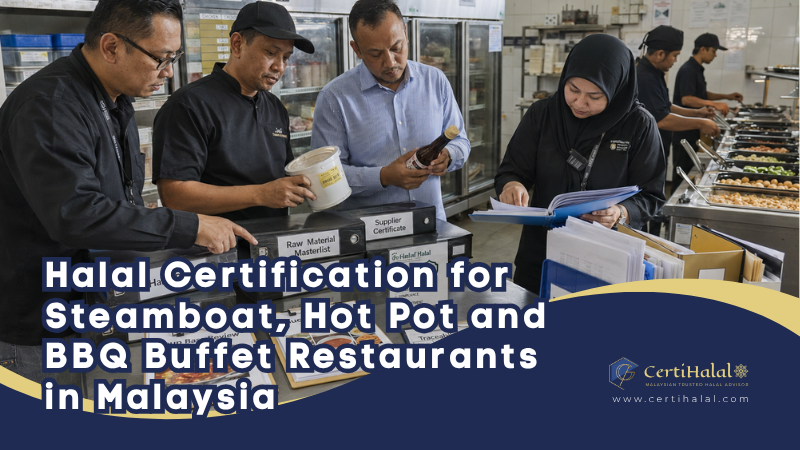
The first step is to build a proper Raw Material Masterlist. This should record all ingredients used in the business, including the product name, supplier, manufacturer, source, halal certificate status, expiry date and supporting documents.
Under MHMS 2020, raw material control should cover purchasing, receiving and storage, and the Raw Material Masterlist should be available for review during halal certification inspection.
Meat, Poultry and Seafood Items
Meat and poultry must be properly verified, especially regarding slaughter source, supplier approval, and halal certification status.
Processed seafood and frozen items should also be reviewed carefully. Items such as fish balls, crab sticks, meatballs, dumplings, and processed fillings may contain binders, flavourings, starches, additives, or other ingredients that require supporting documentation.
Soup Bases, Broths and Seasoning Pastes
Soup bases are central to steamboat and hot pot dining. They often contain multiple ingredients, including stock powder, seasoning paste, extracts, oils, flavour enhancers, spices and sometimes imported components.
Because customers consume the soup directly and cook ingredients in it, the halal status of the soup base must be clearly verified.
Sauces, Marinades and Condiments
Dipping sauces, BBQ marinades and seasoning mixtures are often overlooked. These items may contain fermented ingredients, flavour enhancers, emulsifiers, vinegar, extracts or other processed components.
For halal certification readiness, restaurant owners should not assume that a sauce is acceptable simply because it is commonly used in food service. The source of the ingredients and supporting documents should be checked.
Imported and Processed Ingredients
Imported ingredients may require additional attention because halal recognition, labelling and documentation may differ by country.
If the business uses imported soup paste, seasoning powder, frozen processed food, sauce or marinade, the supporting documents should be reviewed early to avoid certification delays.
What to Prepare Before Applying for Halal Certification
Before applying, restaurant owners should review their operations as if they are already being audited. This means checking whether the documents and actual practices match.
Many halal certification issues arise not because the business intentionally ignores halal requirements, but because the records are incomplete, staff practices are inconsistent, or the daily operations do not match the submitted documents.
Business and Premises Documents
The restaurant should have proper business registration, licensing and premises-related approvals where applicable.
These documents help establish the business identity, operating location and scope of activity before the halal certification process moves deeper into ingredient and operational review.
Halal Policy
The halal policy should clearly express the company’s commitment to halal compliance. It should not exist only as a document in a file.
Staff should understand what the policy means in daily operations, especially those involved in purchasing, receiving, storage, preparation, buffet replenishment and customer service.
Approved Supplier List
Only approved suppliers should be used for halal-controlled ingredients. Any change of supplier should be reviewed and recorded.
This is especially important for restaurants that rely on multiple suppliers for meat, poultry, seafood, vegetables, sauces, frozen items and dry goods.
Raw Material Masterlist
All ingredients, sauces, soup bases, processed items and packaging-related materials should be listed and supported by documents.
The Raw Material Masterlist should be kept up to date whenever there is a new ingredient, a supplier change, a product replacement, or a certificate expiry.
Standard Operating Procedures
SOPs should cover purchasing, receiving, storage, preparation, buffet handling, cleaning, traceability and corrective action.
For steamboat and BBQ buffet restaurants, SOPs should also address shared utensils, grill plates, hot pot equipment, buffet tray labelling, customer self-service monitoring and food replenishment.
Training Records
Kitchen staff, outlet managers, procurement personnel and storekeepers should understand their halal responsibilities.
Training records help show that halal procedures have been communicated and that the business is not relying only on verbal instruction.
Traceability Records
The business should be able to trace ingredients from supplier to storage, preparation and final serving.
For restaurants with central kitchens or multiple outlets, traceability may also involve production logs, delivery records, outlet stock movement and branch-level documentation.
Internal Halal Controls for Daily Restaurant Operations
Daily control is where halal assurance becomes real. A restaurant may have good documents, but if staff are not trained or buffet procedures are unclear, the system becomes weak.
For hot pot and BBQ buffet restaurants, daily controls should include clear labelling of buffet trays, separate utensils for different ingredients, proper monitoring of customer self-service areas, controlled cleaning of grill plates and hot pot equipment, and clear handling procedures for food replenishment.
Staff should know what to do if the wrong ingredient is delivered, a supplier certificate has expired, or a product is found to be different from the approved list. Corrective action records should be kept so that the business can show how problems were managed.
Buffet Display and Replenishment Control
Buffet trays should be clearly labelled and monitored. Replenishment should be done using approved ingredients from approved storage areas.
Staff should avoid topping up food without first checking whether the product is on the approved list. This is especially important when several similar-looking processed items are used.
Utensil and Equipment Control
Tongs, ladles, grill plates, hot pot pots and serving tools should be properly assigned, cleaned and monitored.
Where possible, each food item should have its own utensil. If utensils are mixed, dropped or contaminated, staff should know the correct action to take.
Receiving and Storage Control
Ingredients received from suppliers should be checked against approved records. The product name, supplier, halal certificate status, expiry date, and delivery documents should match the approved values.
Storage should also prevent confusion between approved and unapproved items. Clear labelling helps staff identify the correct products during preparation.
Corrective Action and Incident Handling
If a non-conformance occurs, the business should not ignore it or handle it verbally only. It should record what happened, what action was taken, who was responsible and how recurrence will be prevented.
This creates evidence that the halal system is being actively managed.
Multi-Outlet Restaurant Compliance and Outlet Consistency
For a single outlet, the owner can often monitor operations directly. For a multi-outlet restaurant, the challenge is consistency.
If a restaurant chain has a central kitchen, several outlets and different outlet managers, the halal system must be standardised across the network. Approved recipes, supplier lists, storage practices and buffet handling procedures should not differ from one branch to another without proper review and approval.
For chain food premises, MHMS 2020 requires comprehensive HAS implementation. It also refers to requirements such as appointing a Halal Executive at management or central kitchen level, preparing HAS documents for inspection, ensuring internal halal audits are carried out across the chain premises, and maintaining a list of premises under the same brand or ownership.
Central Kitchen Control
If a central kitchen prepares soup bases, sauces, marinades, or processed ingredients for outlets, it becomes a key halal control point.
The business must ensure that ingredients used at the central kitchen are approved, properly stored, correctly prepared and traceable before being distributed to branches.
Branch-Level Compliance
Each outlet should be audit-ready. The head office cannot only prepare documents centrally while assuming that every outlet follows the same practice.
Branch-level records, staff training, ingredient handling, buffet monitoring and internal audit follow-up are essential.
Standardised Recipes and Supplier Control
Multi-outlet restaurants should maintain standardised recipes and approved supplier lists across all relevant outlets.
Outlet staff should not change ingredients, replace sauces or source emergency stock from unapproved suppliers without proper approval.
Internal Halal Audit Across Outlets
Internal halal audits help identify whether each outlet is following the approved system.
These audits should check both documents and actual operations, including storage, preparation, buffet handling, utensils, staff understanding and corrective action records.
Common Mistakes That Delay Halal Certification
The most common mistake is assuming that “pork-free” means the restaurant is halal-ready. For certification purposes, the business must control the entire halal chain, not just remove pork from the menu.
Other common mistakes include incomplete supplier certificates, expired halal documents, unlisted ingredients, undocumented recipe changes, unclear soup base ingredients, shared utensils without proper controls, unlabelled buffet trays, and staff who cannot explain halal procedures.
For steamboat and BBQ buffet restaurants, sauces and soup bases are often overlooked. These items may contain multiple ingredients, imported seasonings or flavour components that require verification.
If the business cannot prove the source and status of these ingredients, its certification preparation is weakened.
Incomplete Supplier Certificates
Supplier certificates should be valid, relevant to the actual product used and properly filed. A certificate that has expired or does not match the product may create problems during review.
Restaurant owners should monitor certificate expiry dates before submission, not only when an auditor asks for them.
Unlisted Ingredients and Recipe Changes
Every ingredient used in the restaurant should be listed. This includes small items such as seasoning powder, oil, sauces, soup paste, marinade, topping, dipping sauce and frozen processed ingredients.
If the kitchen changes a recipe or uses a substitute ingredient, the change should be reviewed and documented.
Weak Buffet and Utensil Control
Buffet operations are dynamic. Customers move around, utensils are used repeatedly, trays are refilled and food is displayed openly.
Without clear procedures, staff may not know how to respond when utensils are mixed, labels are unclear or food items are placed in the wrong tray.
Staff Who Do Not Understand Halal Procedures
Documents alone are not enough. Staff should be able to understand and follow halal procedures during daily operations.
If staff cannot explain basic handling rules, ingredient controls or corrective actions, it may indicate that the halal system is not properly implemented.
Building Customer Confidence Through Halal Readiness
For steamboat, hot pot and BBQ buffet restaurants, halal certification readiness is not just about passing inspection. It is about building customer confidence through consistent operations.
Muslim consumers want assurance that the restaurant’s ingredients, soup bases, sauces, utensils, storage, preparation and serving processes are properly controlled. This confidence is especially important in buffet environments where many ingredients and shared tools are used simultaneously.
A clear halal system also benefits the business. It reduces confusion among staff, prevents risky shortcuts, improves supplier control, supports future renewal and strengthens brand credibility.
For multi-outlet restaurants, a robust halal system also helps maintain brand consistency. Customers should be able to expect the same halal confidence whether they visit one outlet or another.
Conclusion
For steamboat, hot pot and BBQ buffet restaurants, halal certification is not just about attracting Muslim diners. It is about building a reliable operating system that protects halal integrity from supplier selection to final service.
A restaurant that wants to be halal-ready must control ingredients, soup bases, sauces, shared utensils, buffet handling, staff practices, traceability and documentation. For multi-outlet restaurants, the system must also be consistent across branches.
The earlier these controls are built into daily operations, the smoother the certification journey becomes. Instead of preparing documents only when an application is submitted, restaurant owners should treat halal readiness as an operating discipline.
In practical terms, halal certification readiness gives business owners three important advantages: clearer compliance, stronger customer confidence and better preparation for future renewal. For steamboat, hot pot, and BBQ buffet restaurants, this is especially important because halal assurance depends not only on what is served but also on how the entire dining process is managed.
FAQ
1. Can steamboat and hot pot restaurants apply for halal certification?
Yes. Steamboat, hot pot and BBQ buffet restaurants can prepare for halal certification if their ingredients, suppliers, preparation processes, utensils, storage areas and documentation are properly controlled.
2. Is pork-free enough for halal certification?
No. Pork-free only means pork is not served. Halal certification also looks at ingredient sources, meat slaughter status, sauces, processing aids, storage, preparation, equipment and handling practices.
3. Are halal meat suppliers enough to prove halal compliance?
No. Halal meat suppliers are important, but the restaurant must also control receiving, storage, preparation, cooking, serving and traceability. Supplier certification alone does not prove full compliance with the premises.
4. Why do soup bases need halal review?
Soup bases may contain meat stock, seasoning powder, extracts, flavour enhancers, fermented ingredients or imported pastes. These ingredients must be verified because the soup base is central to steamboat and hot pot dining.
5. What documents are needed before applying?
Common documents include halal policy, supplier halal certificates, Raw Material Masterlist, approved supplier list, menu list, SOPs, delivery orders, invoices, training records, audit records and traceability records.
6. How should buffet utensils be controlled?
Each food item should have its own utensil where possible. Tongs, ladles, and serving tools should be monitored, cleaned, and replaced as needed to reduce the risk of cross-contact.
7. Do staff need halal training?
Yes. Staff should understand halal handling, ingredient control, storage rules, buffet monitoring, cleaning procedures and what to do when a non-conformance or ingredient issue occurs.
8. What is a Raw Material Masterlist?
A Raw Material Masterlist is a structured list of all ingredients and materials used by the restaurant. It records supplier details, product sources, halal certificate status, expiry dates and supporting documents.
9. What should multi-outlet restaurants prepare?
They should prepare centralised SOPs, approved recipes, outlet lists, branch-level records, evidence of staff training, internal audit reports, and consistent supplier controls across all outlets.
10. How can halal advisory support help before submission?
Halal advisory support can help identify documentation gaps, review ingredient risks, organise supplier records, prepare SOPs, train staff and conduct internal readiness checks before formal submission.
Disclaimer:
This content is for informational purposes only and does not constitute legal or regulatory advice. Halal certification decisions are subject to the requirements and approval of Jabatan Kemajuan Islam Malaysia and relevant authorities.