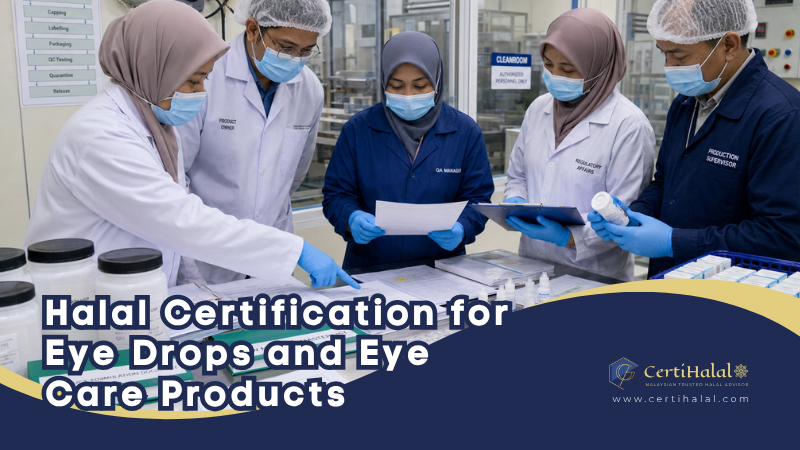
Halal Certification for Eye Drops and Eye Care Products
Published on 25 May 2026Table of Contents
Introduction
Eye drops are often discussed during Ramadan because many Muslims want to know whether using them will invalidate fasting. From a religious-use perspective, this question is important. However, for business owners, manufacturers and product owners, there is another question that must be answered separately: can the eye drop product itself be halal-certified?
These two questions are not the same. A product may be considered permissible to use while fasting based on a fiqh discussion, but that does not automatically mean the product has halal certification.
For halal certification, the focus is not only on how the product is used. It also looks at what the product contains, where the ingredients come from, how it is manufactured, how it is documented and whether the halal claim is accurate.
For eye drop and eye care product owners, this distinction is important. If a company wants to market its product to Muslim consumers, enter halal-sensitive markets or strengthen consumer confidence, it must understand what halal certification actually requires.
Under Malaysia’s halal management framework, MHMS 2020 covers both the Internal Halal Control System for small and micro industries and the Halal Assurance System for medium and large industries. It also places responsibility on the company or applicant to comply with Malaysian halal certification requirements at all times.
Eye Drops During Fasting vs Halal-Certified Eye Drops
The fasting question is about worship. A person may ask: “If I use eye drops while fasting, does my fast remain valid?” This is usually answered through Islamic jurisprudence and religious guidance.
The halal certification question is different. A business owner should ask: “Can I prove that this product is halal-compliant from formulation to finished product?”
For example, an eye drop may be used externally, but the product still contains ingredients. These may include active ingredients, preservatives, solvents, buffering agents, stabilisers or other excipients.
Some ingredients may be synthetic, mineral-based, plant-based, microbial-derived, fermentation-derived or animal-derived. If the source is unclear, the halal status may also be unclear.
This is why a product owner should not use fasting-related statements as a replacement for halal certification. “Safe to use while fasting” and “halal-certified” communicate different things. The first relates to religious use during fasting. The second relates to product compliance, ingredient control, manufacturing control and certification evidence.
Religious Use and Product Certification Are Different Issues
A religious-use discussion usually focuses on whether using eye drops affects a person’s fast. Halal certification focuses on the product itself.
For businesses, this difference matters because marketing language must not confuse consumer understanding. A statement about fasting should not be presented as proof of halal certification.
Halal Certification Looks at the Whole Product
Halal certification does not only check whether the eye drop is used externally. It considers the formulation, ingredient sources, supplier documents, manufacturing process, storage, packaging, traceability and labelling claims.
A product may appear simple, but the halal review may still involve several technical documents and supplier confirmations.
Product Claims Must Be Evidence-Based
Product owners should be careful when using words such as “halal”, “halal-certified”, “Muslim-friendly” or “safe to use while fasting”.
Each phrase may create a different expectation. Claims should only be used when the business has the right evidence to support them.
What Product Owners Need to Check Before Applying
Before applying for halal certification, the product owner must define what is being certified. Is it one eye drop product, a range of eye care products, a manufacturing site, an OEM product or a product made by a contract manufacturer?
This matters because halal certification depends on scope. If the product owner owns the brand but production is done by an OEM or contract manufacturer, the manufacturing site, formulation, raw materials and supporting documents still need to be reviewed.
A simple preparation review should cover the product formula, product category, manufacturing site, supplier list, ingredient sources, packaging and labelling, batch and traceability records, and halal claim wording.
The business should also decide what it wants to claim. There is a difference between saying “halal-certified”, “halal-compliant”, “suitable for Muslim consumers” and “safe to use while fasting”. Each phrase can create a different consumer expectation.
For business owners, the safest approach is to make claims only when the evidence supports them. If formal certification has not been approved, the business should avoid presenting the product as already halal-certified.
Product Scope
The first step is to define the exact product or product range to be certified.
A company should know whether the application covers a single eye drop, several eye care products, different product variants, or a wider product line under the same brand.
Manufacturing Scope
The manufacturing site must also be reviewed. If an OEM or contract manufacturer makes the product, the product owner still needs access to formulation, raw material, supplier, production and traceability documents.
The fact that production is outsourced does not remove the need for halal control.
Labelling and Claim Scope
The company should review its packaging, website, product descriptions and advertising claims.
If halal certification has not been approved, the business should avoid language that suggests the product is already certified. This helps prevent misleading claims and protects consumer trust.
Ingredient and Supplier Documents That Matter
In halal certification, ingredient verification is one of the most important steps. For eye drops, this includes both the active pharmaceutical ingredient and the inactive ingredients.
Inactive ingredients are often called excipients. They may not be the “main medicine”, but they still matter for halal review. Preservatives, solvents, stabilisers, buffering agents, thickening agents, and other formulation aids may have their own sources and manufacturing histories.
Business owners should pay close attention to active ingredients, excipients, preservatives, solvents, stabilisers, buffering agents, animal-derived ingredients, alcohol-related ingredients, fermentation-derived materials and processing aids.
A common mistake is checking only the active ingredient. This is not enough. A product may have a halal-compliant active ingredient but still contain an excipient with unclear source documentation.
A proper halal readiness review should include supplier halal certificates where available, product specifications, Certificate of Analysis, Certificate of Origin, Material Safety Data Sheet and any ingredient declaration or manufacturing flow chart from the supplier.
The company should also maintain an Approved Supplier List. This helps demonstrate that raw materials are purchased from controlled, documented sources rather than being acquired freely without review.
Active Ingredients
The active ingredient should be reviewed for its source, manufacturing background and supporting documents.
Even if the active ingredient appears acceptable, the company should keep proper evidence from the supplier or manufacturer.
Excipients and Preservatives
Excipients and preservatives are important because they are part of the finished formulation.
For eye drops, these may include stabilisers, solvents, buffering agents, viscosity agents, preservatives and other formulation aids. Their source and processing method should be checked.
Animal-Derived and Fermentation-Derived Materials
Any animal-derived material requires careful review because the halal status depends on the animal source, slaughter status and processing background.
Fermentation-derived materials may also require verification, especially if the production medium, processing aids or downstream process are unclear.
Supplier Supporting Documents
Supplier documents help prove the source and status of each ingredient.
Important records may include halal certificates, product specifications, Certificates of Analysis, Certificates of Origin, Material Safety Data Sheets, ingredient declarations, and manufacturing flow charts.
Raw Material Masterlist and Documentation Readiness
One of the most important records for halal certification is the Raw Material Masterlist. This is a structured list of all materials used in the product.
For an eye drop product, the Raw Material Masterlist should normally include raw material name, trade name or code, source of material, supplier name, manufacturer name, halal certificate status, certificate expiry date, supporting documents and remarks on doubtful or non-certified materials.
MHMS 2020 states that companies should establish a Raw Material Masterlist that can be reviewed during halal certification inspection. It also requires the list to include information such as the raw material name, source, manufacturer details, halal certificate information, expiry date, and supporting documents for materials that do not have halal certification.
For business owners, this means halal preparation is not only about getting a certificate at the end. It starts with organising product information properly. If the company cannot show where an ingredient comes from, who manufactured it and what documents support it, the halal review becomes more difficult.
Documentation should be kept updated. Expired halal certificates, outdated product specifications or missing supplier documents may delay the application.
Ingredient Identification
Each material should be clearly identified by name, trade name, code or internal reference.
This helps prevent confusion when different manufacturers supply similar ingredients or when the same ingredient is available in multiple product grades.
Supplier and Manufacturer Details
The Raw Material Masterlist should identify both supplier and manufacturer details where applicable.
This is important because the supplier selling the material may not be the actual manufacturer. Halal review may require information about the manufacturing source.
Halal Certificate Status
The company should record whether each material has halal certification, which body issued the certificate and when the certificate expires.
Expired certificates should be tracked early to avoid problems during review or inspection.
Supporting Documents for Non-Certified Materials
Not every material may have a halal certificate. Where halal certification is not available, supporting documents become more important.
These may include product specifications, source declarations, manufacturing flow charts, Certificates of Analysis, Certificates of Origin, and Material Safety Data Sheets.
Manufacturing Controls and Traceability
Halal certification also considers how the product is manufactured. Even if the formula looks acceptable, the production process still needs to be controlled.
For eye drops and eye care products, manufacturing controls may include receiving of raw materials, storage and segregation, weighing and dispensing, formulation or compounding, filling and sealing, packaging and labelling, cleaning procedures, shared equipment control and non-conforming material handling.
If the same manufacturing line is used for other products, the company should be able to explain how the risk of cross-contamination is controlled. Cleaning records, production procedures and segregation practices become important.
Traceability is another key area. A product owner should be able to trace materials from the supplier to the finished product and from the finished product to distribution.
MHMS 2020 defines traceability as the ability to identify and trace raw materials and products through stages such as receiving, processing, storage and distribution across the halal supply chain.
For eye drops, traceability may include batch numbers, lot numbers, manufacturing records, quality control records, delivery orders, invoices and distribution records. If a halal issue is discovered, the business should be able to identify the affected batch and take appropriate action.
Raw Material Receiving and Storage
Raw materials should be received in accordance with approved supplier and ingredient records.
Storage should prevent confusion between approved and unapproved materials. Clear labelling, segregation and stock control help support halal traceability.
Formulation, Filling and Packaging
The formulation and filling process should follow approved procedures. Any material used during compounding, filling, sealing or packaging should match the approved product records.
Packaging and labelling should also be controlled so that halal claims are used accurately.
Cleaning and Shared Equipment Control
If equipment is shared with other products, the company should have clear cleaning procedures and records.
This helps demonstrate that the production process is controlled and that the risk of cross-contamination is managed.
Batch and Distribution Traceability
Batch numbers, lot numbers, production records and distribution records help the company trace finished products.
This is important if a product issue arises and the company needs to identify affected batches, customers or distribution channels.
Common Mistakes That Delay Halal Certification
Many product owners delay halal certification because they assume the product is simple. Eye drops may look straightforward, but the halal review can become complicated when ingredient sources and supplier documents are incomplete.
Common mistakes include assuming “safe to use while fasting” means halal-certified, checking only the active ingredient, ignoring excipients and preservatives, not verifying animal-derived sources, relying on verbal supplier confirmation, using expired halal certificates, missing Certificate of Origin or Certificate of Analysis, changing suppliers without updating records, weak traceability records and making halal claims before certification approval.
Another common mistake is treating halal certification solely as a marketing step. In reality, it is a compliance process. The product must be supported by proper documents, controlled suppliers, manufacturing evidence and traceability.
For companies planning to export to Muslim-majority markets, these controls become even more important. Buyers, distributors, and regulators may request clearer evidence of halal status, especially for healthcare- and pharmaceutical-related products.
Confusing Fasting Guidance with Certification
One of the most common mistakes is using fasting-related guidance as though it proves the product is halal-certified.
These are separate matters. A product may be considered permissible for use during fasting, but formal halal certification still requires evidence of the product and its manufacturing process.
Checking Only the Active Ingredient
Product owners may focus only on the active ingredient and overlook excipients, preservatives, solvents or stabilisers.
This can create gaps because every ingredient in the formulation should be reviewed.
Relying on Verbal Supplier Confirmation
Verbal assurance from suppliers is not enough for halal certification readiness.
The business should keep written documents that support the source of ingredients, halal status, product specifications, and manufacturing background.
Making Claims Before Approval
A product should not be presented as halal-certified before formal approval has been obtained.
Premature claims can mislead consumers and weaken the company’s credibility.
Building Consumer Confidence Through Halal-Certified Eye Care Products
For Muslim consumers, eye care products may raise questions because they are used on the body and may be discussed in relation to fasting, religious practice and personal confidence.
A halal-certified product can help reduce uncertainty by showing that it has undergone a structured review of ingredients, suppliers, manufacturing controls, and documentation.
For business owners, halal certification can also support market positioning. It may help the product appeal to Muslim consumers, pharmacies, distributors, healthcare retailers and export markets where halal assurance is valued.
However, the value of halal certification depends on preparation. A company that organises its documents, verifies suppliers and controls manufacturing early is in a stronger position to avoid delays and communicate confidently.
Stronger Muslim Consumer Trust
Halal certification can help consumers feel more confident about the product’s ingredients and production background.
This is especially useful when the product is marketed in Muslim-majority markets or during periods when fasting-related questions become more common.
Better Export and Distribution Readiness
Distributors and retailers may request halal documentation, especially for products entering halal-sensitive markets.
A properly prepared halal system can make the product more credible during business development and export discussions.
Clearer Product Communication
When certification status and product claims are clear, consumers are less likely to misunderstand the product.
This protects both the brand and the customer.
Conclusion
Eye drops may be allowed during fasting, according to relevant religious discussions, but that does not automatically make the product halal-certified.
For business owners, halal certification depends on proof. The company must be able to show that the ingredients are properly verified, suppliers are documented, manufacturing is controlled, records are traceable and product claims are accurate.
A well-prepared eye care product business should begin by reviewing its formulation, supplier documents, Raw Material Masterlist, manufacturing process and labelling claims. This preparation helps reduce certification delays and builds stronger confidence among Muslim consumers.
In simple terms, halal certification for eye drops is not about whether the product breaks fasting. It is about whether the product’s full halal compliance can be proven from source to shelf.
Frequently Asked Questions (FAQ)
1. Do eye drops need halal certification?
Eye drops do not automatically require halal certification, but product owners may apply for halal certification if they want to serve Muslim consumers, strengthen trust or enter halal-sensitive markets.
2. Is using eye drops while fasting the same as halal certification?
No. Using eye drops while fasting is a question of religious use. Halal certification is a product compliance question that involves ingredients, suppliers, manufacturing, documentation, and traceability.
3. What ingredients should business owners check?
Business owners should check active ingredients, preservatives, solvents, stabilisers, buffering agents, excipients, animal-derived ingredients, alcohol-related ingredients and processing aids.
4. Are preservatives and excipients important for halal certification?
Yes. Excipients and preservatives may not be the main active ingredient, but they are still part of the product formulation and should be verified.
5. What documents should product owners prepare?
Important documents include product formulation, Raw Material Masterlist, approved supplier list, supplier halal certificates, product specifications, Certificate of Analysis, Certificate of Origin, delivery orders, invoices and traceability records.
6. What is a Raw Material Masterlist?
A Raw Material Masterlist is a structured list of all materials used in the product. It records ingredient names, sources, suppliers, halal certificate status, certificate expiry dates and supporting documents.
7. Does the factory need to be checked?
Yes. The manufacturing process matters. The facility, production line, storage area, cleaning procedure, packaging process and traceability system may all affect halal certification readiness.
8. Can OEM or contract-manufactured eye drops apply for halal certification?
Yes, but the product owner must ensure the OEM or contract manufacturer can provide the necessary formulation, manufacturing, supplier, traceability and halal compliance documents.
9. Can I say my eye drops are halal before certification is approved?
A business should avoid saying a product is halal-certified before formal approval. Claims should be accurate and should not mislead consumers about the product’s actual certification status.
10. How can halal advisory support help?
Halal advisory support can help review ingredients, organise supplier documents, prepare the Raw Material Masterlist, check manufacturing controls, improve traceability and reduce delays before application.
Disclaimer:
This content is for informational purposes only and does not constitute legal or regulatory advice. Halal certification decisions are subject to the requirements and approval of Jabatan Kemajuan Islam Malaysia and relevant authorities.