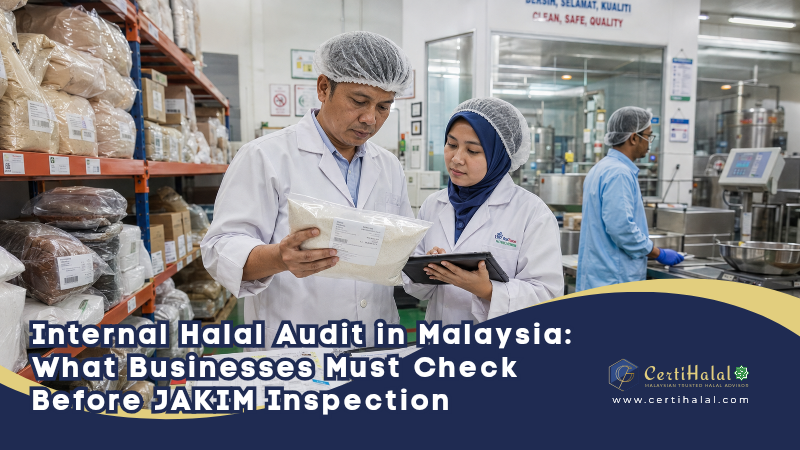
Internal Halal Audit in Malaysia: What Businesses Must Check Before JAKIM Inspection
Published on 14 September 2026Table of Contents
An internal halal audit should not be treated as a last-minute document check before a certification inspection.
Its real purpose is to test whether the business can prove that its halal controls are working in daily operations.
Under MHMS 2020, an Internal Halal Audit is a planned internal examination carried out by the company to ensure compliance with Malaysian Halal Certification requirements. For businesses operating a Halal Assurance System (HAS), the audit should cover compliance with the certification procedures and relevant Halal Control Points.
In everyday business language, people often refer to the external assessment simply as a “JAKIM inspection”. Depending on the certification context, however, the competent authority may be JAKIM, MAIN or JAIN.
The practical question for a business owner is therefore not:
“Are our halal files ready?”
It is:
“If an inspector selects one ingredient, one batch, one employee and one Halal Control Point at random, can we prove that our halal controls are actually working?”
First Confirm Whether HAS or IHCS Applies
Before planning an internal halal audit, determine which halal management system applies to the business.
MHMS 2020 distinguishes between the Halal Assurance System (HAS) and the Internal Halal Control System (IHCS). HAS contains a broader set of controls, including internal halal auditing, Halal Risk Control, training, traceability, HAS Review, documentation and other requirements. IHCS contains a more limited set of minimum internal controls centred on halal policy, raw material or halal risk control, and traceability.
Formal Internal Halal Audit requirements are structured under HAS. Businesses operating IHCS still need to maintain and verify the controls required under their applicable certification scheme, even though the full HAS audit framework does not apply in the same way.
Start with Halal Governance and Audit Responsibility
[Internal link suggestion: Link to “Halal Assurance System (HAS) in Malaysia: What Companies Must Build and Maintain” using anchor text “how the Halal Assurance System should function”]
Start with Halal Governance and Audit Responsibility
An internal audit should begin by checking whether the people responsible for halal compliance are actually functioning in their assigned roles.
Where required, review the appointment and competency of the Halal Executive. Check whether the Internal Halal Committee, or Jawatankuasa Halal Dalaman (JKHD), has been formally established and whether members understand their responsibilities.
MHMS 2020 requires formal JKHD appointments and defined responsibilities, with participation from relevant functions such as procurement and processing. The committee is also required to meet at least twice a year.
Do not stop at appointment letters.
Check:
- meeting minutes;
- halal-related decisions;
- ingredient and supplier changes;
- corrective-action reviews;
- committee follow-up;
- evidence of management involvement.
A committee that exists only on paper is not the same as an effective halal governance system.
Cross-Check Documents Against What Actually Happens
A good internal audit uses several types of evidence.
1. Document review
What does the SOP say should happen?
2. Interview
What do employees say happens?
3. Observation
What actually happens on the floor?
4. Record sampling
What evidence shows that the control was carried out?
If these four sources tell different stories, the auditor may have found a control weakness.
For example, an SOP may require receiving staff to check halal documentation before accepting materials. If employees cannot explain the check, the receiving area accepts substitutions freely, or there are no completed records, the procedure may exist only on paper.
MHMS 2020 requires halal documentation and records to be maintained, updated and readily available for inspection.
Sample-Test Raw Materials Instead of Checking Certificates in Isolation
Raw material control should be tested physically and through records.
Do not simply open a folder and confirm that halal certificates exist.
Select an ingredient that is physically present in storage and trace it backwards through:
Physical material → Raw Material Masterlist → manufacturer → supplier → purchase record → receiving record → halal evidence
Then compare the details.
The Raw Material Masterlist under MHMS 2020 should include information such as material identity, source, manufacturer, halal certificate information, expiry date and supporting documentation. Processing aids should also be included where applicable.
Internal auditors should challenge discrepancies such as:
- the manufacturer on the packaging does not match the masterlist;
- the supplier has changed;
- the certificate has expired;
- the formulation has changed;
- a processing aid is missing from the masterlist;
- an R&D ingredient has entered production without proper control.
Where a halal certificate is relied upon, verify that the issuing body and certificate status satisfy the applicable Malaysian Halal Certification requirements. A halal-looking logo by itself should not be treated as sufficient evidence.
Challenge Purchasing, Receiving and Storage Controls
The auditor should test whether an unapproved material could enter production.
Start with procurement.
Select recent purchase records and check whether materials came from approved sources. Then follow the materials into receiving and storage.
At receiving, verify whether staff check:
- material identity;
- manufacturer;
- supplier;
- halal evidence;
- delivery documentation;
- condition of the material.
Where materials are doubtful, damaged, inconsistent with specifications or otherwise non-compliant, check whether they are quarantined or rejected according to procedure.
The key audit question is:
Could a substitute or unapproved material enter halal production without anyone detecting it?
If yes, the control is not strong enough.
Challenge Every Halal Control Point
A Halal Control Point, or HCP, is a point where halal risk must be identified and controlled so that contamination or non-compliance can be prevented or eliminated. MHMS 2020 links HCP determination with process flow and floor-plan considerations.
An internal auditor should not simply confirm that an HCP appears in a chart.
For each HCP, ask:
- What halal risk was identified?
- Why is this point important?
- What control is applied?
- Who performs the control?
- How often is it performed?
- What record proves it?
- What happens when the control fails?
- Has the corrective action ever been tested?
The MHMS 2020 risk-management structure connects HCPs with halal risk, control mechanisms, corrective action and records.
A useful audit formula is:
Risk → Control → Responsible Person → Record → Corrective Action
Walk the Premises and Observe Actual Practice
Document review should always be followed by physical inspection.
Walk through the operational process from receiving to storage, processing, packaging and dispatch.
Observe whether:
- approved materials are actually being used;
- materials are properly identified;
- doubtful materials are controlled;
- equipment is used according to procedure;
- storage controls are followed;
- production practices match the documented process;
- packaging and labels correspond with approved products.
A strong audit should deliberately look for differences between what the company says it does and what employees actually do.
Interview Employees About Their Own Tasks
Do not test employees only on general halal knowledge.
Test whether they understand the halal controls connected to their own jobs.
Ask purchasing staff:
- What happens before a new supplier is approved?
- Can you substitute an ingredient if stock is unavailable?
Ask receiving staff:
- What do you check when material arrives?
- What happens if the material does not match the approved record?
Ask production staff:
- How do you know an ingredient is approved?
- What should you do if you suspect contamination?
Ask warehouse staff:
- Where are rejected or doubtful materials placed?
- How do you prevent accidental use?
Training records matter, but operational understanding matters too.
MHMS 2020 contains halal awareness and competency requirements for relevant personnel operating under HAS.
Test Traceability with a Real Batch
A traceability system should be tested, not assumed.
Select one finished product and trace it backwards:
Finished product → batch → production record → raw materials → supplier → manufacturer → halal evidence
Then reverse the exercise.
Select one raw material and determine which batches, finished products and distribution records are connected to it.
MHMS 2020 requires traceability through stages including receiving, processing, storage and distribution. Businesses required to implement HAS must also carry out a mock recall at least once annually.
A mock recall that exposes gaps is useful. A mock recall that exposes gaps but results in no corrective action is not.
Check Packaging, Storage, Transportation and Contamination Controls
The audit should continue beyond production.
Review whether finished products remain protected during storage and transportation. Where third-party logistics providers are involved, check relevant contracts, responsibilities and controls.
The auditor should also verify that the business has an appropriate response procedure for contamination incidents, including sertu where applicable.
Under HAS, MHMS 2020 requires a written sertu procedure as preparation for contamination involving najis mughallazah where relevant.
The important point is preparedness.
A contamination procedure should already exist before an incident occurs.
Treat Audit Findings as a Control Test, Not a Failure
Finding a non-conformity during an internal audit does not automatically mean the audit has failed.
The audit is supposed to identify weaknesses before the competent authority does.
When an issue is found, the company should:
Record the finding → correct the issue → verify the correction → check whether the problem can recur
MHMS 2020 requires internal audit non-conformities and corrective actions to be addressed promptly and verified by JKHD. Audit reports and checklists should also be recorded and presented to the committee.
As good audit practice, the business should also determine why the problem occurred so the response addresses the underlying weakness rather than only the immediate symptom.
A repeated finding deserves particular attention because it can indicate that the earlier corrective action or underlying control was ineffective.
Make Sure the Evidence Can Be Retrieved Quickly
A business may possess the correct documents and still struggle during inspection if nobody can find them.
Relevant halal documentation and records under MHMS 2020 must be properly maintained and kept for at least three years. For new applications, at least three months of records should be available for certification inspection purposes.
The three-month requirement relates to new applications. Existing certificate holders should maintain the continuing records required under their applicable halal management system and certification requirements.
Run a retrieval test.
Choose:
- one ingredient;
- one supplier;
- one batch;
- one HCP;
- one employee training record.
Then ask the responsible staff to produce the supporting evidence.
A useful rule is:
Policy tells the auditor what should happen. Records show whether it actually happened.
Final Pre-Inspection Readiness Test
Before an external inspection, the business should be able to answer yes to the following:
- Does the applicable halal management system match the business category?
- Are halal responsibilities clearly assigned?
- Are documents current and consistent with actual operations?
- Do materials in storage match approved records?
- Can supplier and certificate information be verified?
- Are HCPs actively monitored?
- Can employees explain the controls relevant to their jobs?
- Can a finished batch be traced backwards and forwards?
- Have mock recall weaknesses been corrected?
- Have internal audit findings been verified and closed?
- Can records be produced quickly when requested?
The purpose of an internal halal audit is not to create a perfect-looking checklist.
It is to prove that the halal system operates consistently enough to withstand independent examination.
Frequently Asked Questions
1. What is an Internal Halal Audit in Malaysia?
It is a planned internal examination conducted by the company to verify compliance with Malaysian Halal Certification requirements and, where applicable, Halal Control Points under its halal management system.
2. What is the difference between an internal halal audit and a JAKIM inspection?
An internal halal audit is conducted by or for the business to identify and correct weaknesses. A certification inspection is conducted by the applicable competent authority to assess compliance for Malaysian Halal Certification purposes.
3. Does every halal-certified business need the same internal halal audit system?
No. MHMS 2020 distinguishes between HAS and IHCS. Formal Internal Halal Audit requirements are part of HAS, while IHCS contains a more limited set of internal controls.
4. How often must an Internal Halal Audit be conducted?
The general HAS requirement states that an Internal Halal Audit should be conducted at least once annually for each branch or network premises. Businesses should not automatically treat the six-month frequency shown in the sample SOP in Appendix D as a universal requirement.
5. Who can conduct an Internal Halal Audit?
Under MHMS 2020, the auditor should be formally appointed by JKHD and possess the required Internal Halal Auditing or Halal Executive certification from an appropriate registered training provider. Different requirements apply where a third-party auditor is engaged.
6. What should an internal halal auditor check first?
Start with governance, audit responsibility and document control, then sample-test materials, purchasing records, HCPs, actual operating practices, employee understanding and traceability.
7. Should halal certificates be checked individually?
Yes, but not in isolation. The auditor should cross-check the certificate against the Raw Material Masterlist, physical material, manufacturer, supplier, purchase record and receiving record.
8. What should a business do if the audit finds a non-conformity?
Document the finding, implement corrective action promptly, verify the correction through JKHD and determine whether the problem could recur.
9. Is a mock recall required?
For businesses required to implement HAS, MHMS 2020 requires a mock recall at least once annually to test the effectiveness of traceability.
10. How can a business know whether it is ready for halal inspection?
A business is in a stronger position when its documents, physical operations, employee practices and records all support the same halal control system—and when previous internal audit findings have been properly corrected and verified.
Disclaimer:
This content is for informational purposes only and does not constitute legal or regulatory advice. Halal certification decisions are subject to the requirements and approval of Jabatan Kemajuan Islam Malaysia and relevant authorities.