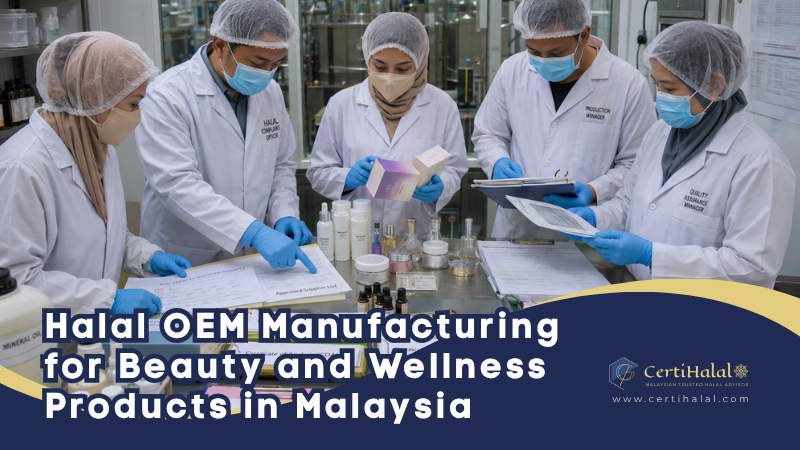
Halal OEM Manufacturing for Beauty and Wellness Products in Malaysia
Published on 26 May 2026Table of Contents
Introduction
Halal OEM manufacturing is becoming increasingly important for beauty, cosmetics, skincare, perfume, aromatherapy and wellness brands in Malaysia. Many business owners want to launch halal products, but they may not own a factory, formulation team or production facility. This is where OEM manufacturing becomes useful.
OEM stands for Original Equipment Manufacturer. In simple terms, an OEM manufacturer produces products on behalf of another brand. The brand owner may provide the product idea, packaging direction and target market, while the OEM manufacturer handles formulation, production, filling, packaging and sometimes regulatory support.
However, when the product is intended to be halal-certified, the process is not only about finding a factory that can produce the product. The business owner must also make sure that the ingredients, suppliers, manufacturing process, documents, packaging claims and traceability records support halal compliance.
For halal OEM manufacturing, the key question is practical: can the product owner and OEM manufacturer prove that the product is halal-compliant from raw material selection to finished product release?
For beauty and wellness brands, halal certification should therefore be treated as part of product development, not as a final marketing label added after production.
What Halal OEM Manufacturing Means for Brand Owners
For brand owners, halal OEM manufacturing means outsourcing product development and production to a manufacturer while ensuring that the product meets halal requirements.
This may involve products such as skincare, cosmetics, perfume, essential oils, aromatherapy products, hair care, body care, wellness products and personal care products.
A common misunderstanding is that choosing an OEM factory that has halal experience automatically makes every new product halal-certified. This is not always true. Each product, ingredient, formulation, process and certification scope must be checked.
For example, a factory may have experience producing halal products, but a new skincare formula may use a fragrance, emulsifier, solvent or active ingredient that has not yet been verified. If the ingredient source is unclear, the product may not be ready for halal certification.
This is why brand owners should treat halal certification as part of product planning, not as the final step after production.
OEM Production Does Not Automatically Mean Halal Certification
An OEM manufacturer may have strong technical capabilities, product development experience and existing halal exposure. However, this does not automatically mean that every new product produced by the factory is halal-certified.
The product formulation, raw materials, suppliers, production process and certification scope must still be reviewed.
Each Product Requires Its Own Halal Readiness Review
A new product may contain different raw materials, fragrances, preservatives, solvents, emulsifiers or active ingredients. Even a small ingredient change may affect halal readiness.
For this reason, brand owners should review each product individually instead of assuming that one successful product approval applies to all future products.
Halal Planning Should Start Before Production
Halal readiness should begin before the formula is finalised, not after packaging has been printed or production has started.
Early review helps reduce reformulation risk, avoid supplier document delays and prevent misleading product claims.
Why Ingredient Verification Comes Before Product Launch
Ingredients are one of the most important parts of halal OEM manufacturing. Beauty and wellness products often contain many types of raw materials, and some may come from animal, plant, mineral, synthetic, microbial or fermentation sources.
For halal certification preparation, business owners should check active ingredients, fragrance, essential oils, plant extracts, emulsifiers, surfactants, preservatives, solvents, colourants, fermentation-derived ingredients, animal-derived ingredients, alcohol-related ingredients and processing aids.
Fragrance and perfume ingredients are especially important because they may contain alcohol-related components or complex blends from multiple suppliers. Skincare and cosmetic products may also include emulsifiers, collagen, gelatine, enzymes, fatty acids, glycerine or other ingredients that require source verification.
A product may look “natural”, “vegan” or “clean”, but those claims are not the same as halal certification. Natural ingredients can still require documentation. Vegan ingredients may reduce some animal-source concerns, but halal certification still requires proper evidence, controlled manufacturing and accurate claims.
For business owners, the safest approach is to verify ingredients before finalising the formula. Changing ingredients later may delay production, packaging design and certification preparation.
Active Ingredients and Functional Materials
Active ingredients should be reviewed according to their source, supplier, manufacturing background and supporting documents.
For skincare and wellness products, active ingredients may include plant extracts, vitamins, peptides, acids, enzymes, oils or other functional materials. Each ingredient should be checked before the formula is finalised.
Fragrance, Perfume and Aromatherapy Ingredients
Fragrance and perfume ingredients require careful attention because they may involve complex blends from different sources.
Perfume, essential oil blends and aromatherapy formulations may also involve alcohol-related ingredients, solvents, carriers or processing aids that require proper halal review.
Emulsifiers, Surfactants and Preservatives
Emulsifiers, surfactants and preservatives are common in beauty and personal care products. They help stabilise texture, improve cleansing performance or extend product shelf life.
However, some may be animal-derived, fermentation-derived or processed using materials that require further verification.
Natural, Vegan and Clean Beauty Claims Are Not the Same as Halal
A product described as natural, vegan or clean may still need halal documentation. These claims do not automatically prove that the product is halal-certified.
Halal certification requires ingredient evidence, supplier control, manufacturing control, traceability and accurate product claims.
Supplier Documents and Raw Material Masterlist Requirements
Good halal preparation depends on good documentation. A brand owner should not rely only on verbal confirmation from the OEM manufacturer or raw material supplier.
Important supplier documents may include supplier halal certificates, product specifications, Certificate of Analysis, Certificate of Origin, MSDS, ingredient declarations, manufacturing flow charts, allergen or contamination information and supporting documents for non-certified raw materials.
One of the most important documents is the Raw Material Masterlist. This is a structured list of all raw materials used in the product. It usually records the ingredient name, supplier, manufacturer, source, halal certificate status, certificate expiry date and supporting documents.
For halal OEM manufacturing, the Raw Material Masterlist helps the business owner and manufacturer identify which ingredients are approved, which need further verification and which may create halal risk.
Another important document is the Approved Supplier List. This shows which suppliers have been reviewed and approved for use. Without supplier control, the manufacturer may change ingredients or suppliers without proper halal review.
This is a common reason why halal certification applications are delayed. The product may be ready physically, but the documentation is not ready for inspection.
Supplier Halal Certificates
Supplier halal certificates should be valid, relevant to the actual material used and properly filed.
A certificate should not be accepted blindly. The product name, manufacturer, certificate scope and expiry date should be checked.
Product Specifications and Technical Documents
Product specifications, Certificate of Analysis, Certificate of Origin, MSDS and manufacturing flow charts help explain what the ingredient is, where it comes from and how it is produced.
These documents are especially important when a raw material does not have its own halal certificate.
Raw Material Masterlist
The Raw Material Masterlist should list every ingredient and material used in the product.
It should include the raw material name, trade name or code, supplier, manufacturer, source, halal certificate status, expiry date, supporting documents and remarks for materials that require further review.
Approved Supplier List
The Approved Supplier List helps control which suppliers can be used.
This is important because changing suppliers without halal review may introduce ingredients with unclear status or incomplete documents.
Manufacturing Controls That Affect Halal Certification
Halal certification does not only look at ingredients. It also looks at how the product is manufactured.
For beauty and wellness OEM products, manufacturing controls may include raw material receiving, storage segregation, weighing and mixing, filling and packing, cleaning procedures, equipment control, packaging material control, labelling control, non-conforming material handling and corrective action records.
If the OEM manufacturer uses shared equipment or shared production lines, there must be clear control procedures. The business should understand how the factory prevents contamination or cross-contact with non-halal or doubtful materials.
Storage is also important. Raw materials should be clearly labelled and stored in a controlled manner. Finished products should be traceable by batch or lot number. Packaging materials should match the approved product and should not contain claims that go beyond the actual certification status.
In simple terms, halal manufacturing is not only about what goes into the product. It is also about how the product is handled at every stage.
Raw Material Receiving and Storage
Raw materials should be received according to approved supplier records and checked against the Raw Material Masterlist.
Storage should be controlled so that approved materials are clearly identified and doubtful or unapproved materials are not accidentally used.
Weighing, Mixing and Production Control
During production, the OEM manufacturer should follow the approved formula and production procedure.
Any change in raw material, supplier, formula, batch process or production method should be reviewed before implementation.
Shared Equipment and Cleaning Procedures
Many OEM factories use shared equipment for different products. This is common, but it must be controlled.
Cleaning procedures, production scheduling, equipment records and segregation practices help show how contamination or cross-contact risk is managed.
Packaging and Labelling Control
Packaging materials must match the approved product and certification status.
If the product has not been formally certified, packaging should not suggest that it is already halal-certified. Labelling control helps prevent misleading claims before approval.
Traceability and Batch Records
Finished products should be traceable by batch or lot number.
Traceability records help identify which raw materials were used, when the product was produced, where it was stored and how it was released or distributed.
Brand Owner vs OEM Manufacturer: Who Is Responsible?
In halal OEM manufacturing, responsibility is shared.
The brand owner is usually responsible for product direction, market claims, packaging approval and understanding what is being sold to consumers. The brand owner should not assume that the OEM manufacturer will handle every halal issue automatically.
The OEM manufacturer is responsible for controlling production, raw material handling, facility readiness, manufacturing records and process compliance.
Both parties should work together on product formulation approval, ingredient verification, supplier document collection, change control, traceability records, packaging and labelling review, corrective action and renewal preparation.
The most important point is clarity. Before production begins, both parties should agree on who will prepare which documents, who will monitor supplier certificate expiry, who will handle changes to raw materials and who will support halal audit preparation.
Without clear responsibility, certification preparation becomes confusing. The brand owner may think the OEM is handling everything, while the OEM may expect the brand owner to approve ingredients and claims.
Brand Owner Responsibilities
The brand owner should understand the product formula, target market, claim strategy and certification objective.
They should also review packaging, product descriptions, halal-related wording and consumer-facing claims before launch.
OEM Manufacturer Responsibilities
The OEM manufacturer should manage production control, raw material handling, storage, manufacturing records, cleaning procedures, equipment control and traceability.
The manufacturer should also support the brand owner with necessary documentation for halal certification readiness.
Shared Responsibilities
Both parties should coordinate on ingredient approval, supplier documents, formulation changes, certification scope, audit preparation and renewal support.
A clear responsibility matrix can reduce confusion and prevent delays.
Halal Claims, Labelling and Consumer Communication
Halal claims must be handled carefully. A product should not be promoted as halal-certified before approval is obtained.
Business owners should understand the difference between halal-certified product, halal-compliant formulation, Muslim-friendly product, alcohol-free claim, vegan claim, natural claim and clean beauty claim.
These terms are not the same. A product can be vegan but not halal-certified. A product can be alcohol-free but still require halal documentation for other ingredients. A product can use mostly natural ingredients but still need supplier verification.
Packaging and advertising should be reviewed before launch. If the product is not yet certified, the business should avoid wording that may mislead consumers. If halal certification is approved, the claim should match the certification scope and approved product name.
This is especially important for online sales, export markets and retail distribution. Consumers may rely heavily on packaging and product descriptions when deciding whether a product is suitable for them.
Halal-Certified vs Halal-Compliant
“Halal-certified” usually means the product has received formal certification under the relevant recognised process.
“Halal-compliant” may suggest that the product is prepared according to halal requirements, but the wording should still be used carefully if formal certification has not been obtained.
Alcohol-Free, Vegan and Natural Claims
Alcohol-free, vegan and natural claims may support product positioning, but they are not replacements for halal certification.
Each claim should be reviewed separately and supported with evidence.
Online Product Descriptions
Online product descriptions are part of consumer communication. If a product is sold through e-commerce, social media or marketplace platforms, the wording should match the actual certification status.
Misleading claims can affect consumer trust and brand credibility.
Common Mistakes That Delay Halal OEM Certification
Many halal OEM certification delays happen because businesses start with branding and packaging before checking halal readiness.
Common mistakes include assuming the OEM factory’s halal experience covers every new product, choosing ingredients before checking halal status, ignoring fragrance and alcohol-related ingredients, missing supplier halal certificates, using expired halal certificates, incomplete Raw Material Masterlist, weak change control after reformulation, packaging claims stronger than certification status, unclear responsibility between brand owner and OEM, poor traceability records and applying before documentation is ready.
The best approach is to review halal readiness early. Before confirming the final formula, business owners should check ingredient sources, supplier documents, production process, packaging claims and certification scope.
This helps reduce delays, avoid reformulation and build stronger trust with Muslim consumers.
Starting with Branding Before Halal Review
Many product owners begin with product name, packaging, marketing claims and launch planning before checking halal readiness.
This can create problems if the final formula contains ingredients that are difficult to verify or if the packaging already contains claims that are not yet supported.
Ignoring Fragrance and Alcohol-Related Ingredients
Fragrance, perfume, essential oil blends and alcohol-related ingredients are commonly overlooked.
These ingredients should be reviewed early because they may involve complex supplier chains or additional halal documentation.
Incomplete Supplier Documents
A product may be physically ready for production, but certification preparation may still be delayed if supplier documents are incomplete.
Missing halal certificates, product specifications, Certificate of Analysis, Certificate of Origin or MSDS can weaken the application.
Weak Change Control
If the formula changes, the halal documentation should also be updated.
Changing a fragrance, preservative, emulsifier, supplier or packaging material without review can affect halal readiness.
Claims Stronger Than Certification Status
Product claims should not go beyond what has actually been approved.
Using strong halal wording before certification approval can mislead consumers and create unnecessary risk for the brand.
Building Consumer Trust Through Halal OEM Readiness
For beauty and wellness brands, halal certification can strengthen consumer trust because it shows that the product has gone through a structured review of ingredients, suppliers, production controls and documentation.
Muslim consumers may pay close attention to skincare, cosmetics, perfume and personal care products because these products are used directly on the body. Clear halal certification can help reduce uncertainty and support stronger brand confidence.
Halal readiness also helps business owners work more professionally with retailers, distributors and export partners. When documents are organised and claims are clear, the product is easier to evaluate and position in halal-sensitive markets.
Stronger Confidence for Muslim Consumers
Muslim consumers may want assurance that the products they use are not only effective, but also aligned with halal expectations.
A properly prepared halal-certified product helps build confidence from ingredient source to finished product.
Better Retail and Export Readiness
Retailers and distributors may request supplier documents, product specifications, halal certificates or certification evidence.
Brands that prepare early can respond more confidently and reduce delays in commercial discussions.
Clearer Brand Positioning
Halal certification can support a brand’s positioning in the beauty and wellness market, especially when combined with accurate communication and responsible claims.
However, the claim must always match the approved certification status.
Conclusion
Halal OEM manufacturing is a powerful option for beauty and wellness business owners who want to launch products without owning a factory. However, halal certification requires more than choosing an OEM manufacturer.
The business must be able to prove that ingredients are verified, suppliers are documented, manufacturing is controlled, records are traceable and product claims are accurate.
For brand owners, the most important step is to treat halal compliance as part of product development from the beginning. When halal readiness is built into formulation, supplier selection, production planning and packaging review, the certification journey becomes smoother.
In simple terms, halal OEM manufacturing is not just about outsourcing production. It is about building a product that can be trusted from formulation to finished product.
FAQ
1. What is halal OEM manufacturing?
Halal OEM manufacturing means producing products through an OEM manufacturer while ensuring the ingredients, production process, documentation and product claims meet halal certification requirements.
2. Can I launch a halal beauty product without owning a factory?
Yes. Many brand owners work with OEM manufacturers. However, the product, ingredients, manufacturing process and documentation must still be properly controlled for halal certification readiness.
3. Does an OEM factory’s halal certification cover every product?
Not automatically. Each product formulation, ingredient list, process and certification scope must be checked. A new product may still require separate review or approval.
4. What ingredients should beauty and wellness brands check?
Brands should check active ingredients, fragrance, essential oils, emulsifiers, surfactants, preservatives, solvents, colourants, animal-derived ingredients and alcohol-related ingredients.
5. Why are fragrance and alcohol-related ingredients important?
Fragrance blends can contain complex ingredients from different sources. Alcohol-related ingredients may also raise halal questions depending on source, use and certification requirements.
6. What documents should business owners prepare?
Important documents include the Raw Material Masterlist, approved supplier list, supplier halal certificates, product specifications, Certificate of Analysis, Certificate of Origin, MSDS and manufacturing flow chart.
7. What is a Raw Material Masterlist?
A Raw Material Masterlist is a structured list of all ingredients and materials used in a product. It records source, supplier, manufacturer, halal certificate status and supporting documents.
8. Who is responsible for halal compliance: the brand owner or OEM manufacturer?
Both have responsibilities. The brand owner controls product claims and market positioning, while the OEM manufacturer controls production. Both must work together on documents, traceability and certification readiness.
9. Can I use halal claims before certification is approved?
A business should avoid claiming a product is halal-certified before formal approval. Product claims should always match the actual certification status.
10. How can halal advisory support help?
Halal advisory support can help review ingredients, check supplier documents, prepare the Raw Material Masterlist, clarify OEM responsibilities, review packaging claims and reduce certification delays.
Disclaimer:
This content is for informational purposes only and does not constitute legal or regulatory advice. Halal certification decisions are subject to the requirements and approval of Jabatan Kemajuan Islam Malaysia and relevant authorities.