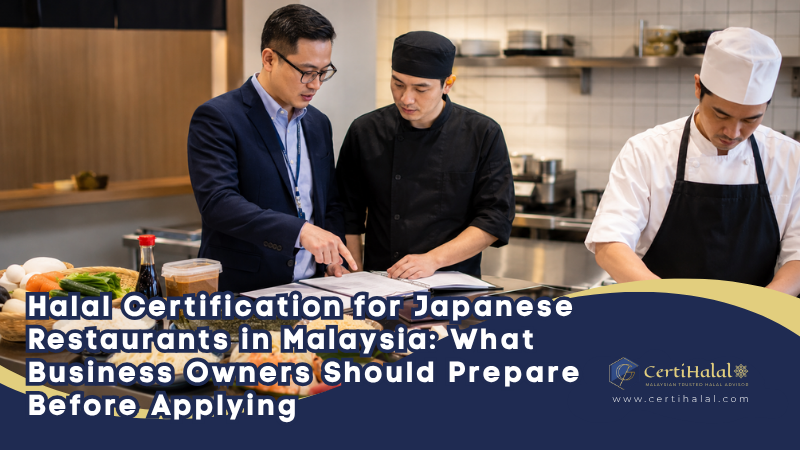
Halal Certification for Japanese Restaurants in Malaysia: What Business Owners Should Prepare Before Applying
Published on 22 June 2026Table of Contents
Introduction
Japanese cuisine has become increasingly popular in Malaysia, from sushi bars and ramen shops to teppanyaki restaurants, donburi outlets, bento operators, and Japanese-style cafés. For business owners who want to serve the Muslim market with confidence, Halal certification is not merely a marketing advantage. It is a structured compliance commitment that affects ingredients, suppliers, kitchen operations, staff training, documentation, and long-term business discipline.
For Japanese restaurants, Halal certification can be more complex than for many other food premises because Japanese cooking often relies on sauces, fermented ingredients, imported seasonings, broths, marinades, seafood products, and alcohol-risk ingredients. A restaurant may be pork-free, but that does not automatically mean it is ready for Halal certification. The business must be able to prove that every ingredient, process, supplier, and handling practice supports Halal integrity.
Why Japanese Restaurants Need Deeper Halal Preparation
A Japanese restaurant applying for Halal certification must first understand that the process is not only about submitting an online application. The real work begins before submission. Business owners need to review the entire menu, identify high-risk ingredients, verify supplier documents, assess kitchen flow, train staff, and ensure that the actual operation matches the declared documents.
Common Japanese menu categories such as sushi, ramen, tempura, teriyaki, yakitori, teppanyaki, Japanese curry, and bento meals may involve ingredients that require careful review. These include soy sauce, miso, mirin, vinegar, dashi, bonito extract, ramen broth base, curry roux, tempura batter, sauces, seafood products, meat, gelatine, emulsifiers, and flavouring. Some ingredients may contain alcohol, animal-based derivatives, or unclear sources. Others may be imported and require proper supporting documents.
From a business owner’s perspective, the key question is not simply, “Can my Japanese restaurant apply?” A better question is, “Is my restaurant operationally and documentarily ready to be audited?”
Understanding the Malaysian Halal Certification Framework
In Malaysia, Halal certification is connected to recognised authorities and official procedures, including JAKIM, JAIN, MAIN, the Halal Malaysia framework, MYeHALAL, MHMS 2020, MPPHM, and relevant Malaysian Standards such as MS 1500. These references help define how a business should control Halal risks and maintain compliance.
For food premises, the internal control structure may involve either an Internal Halal Control System, or IHCS, or a Halal Assurance System, or HAS, depending on the business category, size, and complexity. Smaller food operators may need to implement basic internal Halal controls such as Halal policy, raw material control, risk control, and traceability. Larger or more complex operations, such as chain restaurants, central kitchens, hotel F&B operations, and catering businesses, may require a more complete Halal Assurance System.
For a Japanese restaurant group with multiple outlets or a central kitchen, the compliance burden becomes heavier. It may need stronger governance, formal roles, internal audit, documented procedures, ingredient control, menu change control, and records that can be reviewed during inspection.
The Biggest Halal Risks in Japanese Restaurants
The first major risk is alcohol-related ingredients. Traditional Japanese cooking may use sake, mirin, cooking wine, or alcohol-based flavouring. Even sauces, marinades, desserts, and broths may contain hidden alcohol-related elements. Business owners should not assume that cooking removes the compliance concern. The ingredient must be checked based on its composition, purpose, source, and certification status.
The second risk is fermented and sauce-based ingredients. Soy sauce, miso, vinegar, teriyaki sauce, yakiniku sauce, tonkatsu sauce, ramen seasoning, dipping sauce, and curry roux may look ordinary from a kitchen perspective, but each can contain complex ingredients. The restaurant must obtain valid supplier documents and verify that the product used in the kitchen matches the product declared in the application.
The third risk is meat and animal-based ingredients. Chicken, beef, duck, gelatine, collagen, enzymes, fish cake, crab stick, surimi, fish roe, and broth base must be reviewed carefully. Meat and poultry should come from acceptable Halal sources, while processed seafood products may need ingredient breakdowns and supporting documents.
The fourth risk is imported ingredients. Many Japanese restaurants use imported dry goods, sauces, noodles, snacks, seaweed, seasoning powders, dessert ingredients, and packaged products. Imported ingredients are not automatically acceptable just because they are widely used in Japanese cuisine. The business must keep proper evidence such as Halal certificates, product specifications, ingredient lists, Certificates of Analysis, Certificates of Origin, supplier declarations, and other relevant documents.
Preparing the Menu Before Applying
Before applying, the restaurant should conduct a menu-to-ingredient review. Every dish should be broken down into its ingredients, sauces, toppings, garnishes, cooking aids, and preparation method. For example, a ramen dish may involve noodles, broth, seasoning oil, soy base, miso base, egg marinade, meat topping, seaweed, spring onion, and chilli paste. Each item must be verified.
A sushi menu may involve sushi rice seasoning, seafood, soy sauce, wasabi, pickled ginger, seaweed, fish roe, crab stick, mayonnaise, and dipping sauces. A teppanyaki menu may involve meat, seafood, butter, oil, marinade, dipping sauce, grill surface control, and utensils. A tempura menu may involve batter mix, frying oil, dipping sauce, flour, starch, seafood, vegetables, and fryer management.
This review helps the business owner identify which items are ready, which require supplier documents, which need replacement, and which should be removed or reformulated before application.
Building Supplier and Ingredient Control
A Japanese restaurant should maintain an approved supplier list and a Raw Material Masterlist. The Raw Material Masterlist should clearly record ingredient names, suppliers, product specifications, Halal certificate status, certificate expiry dates, supporting documents, and remarks on risk level.
Supplier control should include certificate validity monitoring, new supplier approval, ingredient substitution control, delivery document checking, and supplier re-evaluation. This is especially important because chefs and purchasing teams may sometimes replace ingredients due to stock availability. From a Halal compliance perspective, an unapproved replacement ingredient can create serious risk.
The purchasing team, kitchen manager, and business owner should work together. Halal compliance cannot be handled only by one person after the food has already been purchased or served. It must be built into procurement decisions.
Kitchen Operations and Halal Control Points
Halal Control Points in a Japanese restaurant may appear at receiving, storage, preparation, cooking, serving, packaging, and delivery. For example, sauces and seasonings must be labelled and stored properly. Meat and seafood should be handled according to approved procedures. Broth preparation should follow declared ingredients. Fryers should not be exposed to unverified items. Utensils, cutting boards, knives, containers, and cleaning tools should be controlled to prevent contamination.
Restaurants that previously served non-Halal items need to be especially careful. Equipment, utensils, storage areas, and surfaces may require proper review and corrective action before the restaurant can move towards Halal certification readiness.
Staff must also understand their roles. Chefs should not change recipes without approval. Purchasing staff should not buy substitute ingredients without checking documents. Storekeepers should verify deliveries. Service staff should avoid making misleading Halal claims before certification is approved.
Audit Readiness and Documentation
During the Halal audit, the restaurant should be ready to show that its documents and operations are aligned. Auditors may review business documents, supplier certificates, ingredient records, menus, kitchen flow, storage practices, training records, and internal responsibilities. They may also inspect the kitchen, observe processes, and interview staff.
Common causes of delay include incomplete documents, expired supplier certificates, ingredient names that do not match certificates, unclear imported ingredient sources, menu items not declared properly, poor traceability records, and staff who cannot explain basic Halal control practices.
If a Non-Conformance Report is issued, the restaurant must respond with corrective action. This may involve replacing ingredients, changing suppliers, updating records, improving storage, retraining staff, or revising procedures.
Maintaining Certification After Approval
Halal certification does not end when approval is granted. After certification, the restaurant must maintain the approved menu, approved ingredients, supplier documents, internal records, and staff awareness. Any new menu item, new sauce, new supplier, new branch, or recipe change should be reviewed before implementation.
For Japanese restaurants, seasonal menus and chef-led innovation can create compliance risk if changes are not controlled. A new ramen broth, dessert flavour, imported sauce, or limited-time bento ingredient may require fresh documentation. Renewal preparation should also begin early, not only when the certificate is close to expiry.
A strong Halal system helps the business protect customer trust, reduce audit stress, support expansion, and maintain credibility in the Muslim dining market.
FAQ
1. Can a Japanese restaurant apply for Halal certification in Malaysia?
Yes. A Japanese restaurant can apply if its ingredients, suppliers, kitchen operations, staff practices, and documentation comply with Halal certification requirements.
2. Is pork-free Japanese food enough for Halal certification?
No. Pork-free does not automatically mean Halal-certified. The restaurant must also control alcohol-risk ingredients, animal-based ingredients, supplier documents, kitchen handling, and traceability.
3. What are the highest-risk ingredients in Japanese restaurants?
Common high-risk items include sake, mirin, cooking wine, soy sauce, miso, dashi, bonito extract, ramen broth, curry roux, sauces, gelatine, enzymes, fish cake, crab stick, and imported seasonings.
4. Can mirin or sake be used in a Halal-certified Japanese restaurant?
Business owners should treat mirin, sake, and cooking wine as critical alcohol-risk ingredients. They should be replaced or reviewed according to current Halal requirements and supporting evidence.
5. Are seafood-based Japanese menus easier to certify?
Not always. Fresh seafood may be lower risk than meat, but processed seafood items such as crab stick, fish cake, surimi, fish roe, sauces, and seasoning still need verification.
6. What documents should a Japanese restaurant prepare?
The restaurant should prepare business registration documents, premise-related documents, menu list, ingredient list, supplier list, Halal certificates, product specifications, invoices, delivery orders, floor plan, process flow, training records, and traceability records.
7. What is the purpose of a Raw Material Masterlist?
A Raw Material Masterlist helps the restaurant track every ingredient, supplier, certificate status, expiry date, product specification, and supporting document. It is a key tool for ingredient control.
8. Do chefs need Halal training?
Yes. Chefs and kitchen staff should understand ingredient risk, sauce and broth control, storage procedures, cleaning practices, and why recipe changes must be approved before use.
9. What can delay a Halal certification application?
Delays may happen when documents are incomplete, supplier certificates are expired, ingredients are not properly declared, imported items lack evidence, staff are not trained, or kitchen practices do not match the submitted documents.
10. How should a Japanese restaurant maintain certification after approval?
The restaurant should monitor supplier certificates, control menu changes, update ingredient records, train new staff, conduct internal checks, maintain traceability, and prepare early for renewal.
Conclusion
Halal certification for Japanese restaurants requires more than replacing pork-based items. It requires a full review of Japanese ingredients, alcohol-risk seasonings, sauces, broths, imported products, suppliers, kitchen practices, documentation, and staff responsibility. For business owners, the best approach is to prepare the restaurant as a complete Halal control environment before applying. When the menu, suppliers, kitchen, staff, and records are aligned, the certification journey becomes more structured, credible, and sustainable.
Disclaimer:
This content is for informational purposes only and does not constitute legal or regulatory advice. Halal certification decisions are subject to the requirements and approval of Jabatan Kemajuan Islam Malaysia and relevant authorities.